Termite Inspections and Wood Destroying Insect Reports in Mississippi and Louisiana
Quick Answer: A termite inspection is a visual check of the accessible parts of a home for termite evidence, damage, and conditions that attract termites. For a home sale, both states use an official Wood Destroying Insect Report. In Louisiana, that report is issued only for a sale or refinance, is not renewable, and does not guarantee repairs.
TLDR:
- A termite inspection is visual. It covers accessible areas and records insect evidence, damage, conducive conditions, and any spots the inspector could not reach.
- For home sales, Louisiana and Mississippi each use an official state Wood Destroying Insect Report form.
- In Louisiana, the report is issued only for a sale or refinance, is not renewable, and does not guarantee repair of damage.
- Louisiana’s report carries a 90-day guarantee: live subterranean termites found in a readily accessible area within 90 days get treated without charge.
- Louisiana bars pest control licensees and their staff from promising free treatment or repairs for insects found more than 90 days after the inspection.
- Mississippi’s rule states there is no warranty, express or implied, on its official report.
- A clean report is a snapshot, not ongoing protection. A termite plan and yearly inspections do that job.
For a lot of buyers and sellers, termite questions show up late: a week or two before closing, when the lender asks for the “termite letter” and nobody is sure what it promises. Pro-Tec Pest Management works on both sides of the state line, from Brandon and Meridian in Mississippi to Baton Rouge, Denham Springs, and Walker in Louisiana.
The two states write their rules differently, so this guide names the state every time the answer depends on one.
Buying, selling, or just want to know where your home stands? Pro-Tec Pest Management inspects homes across Mississippi and Louisiana for termite activity, termite damage, and the conditions that draw termites in.
What a Termite Inspection Actually Looks At
A termite inspection is a visual job. The inspector checks what can be seen and reached, and notes what could not be checked.
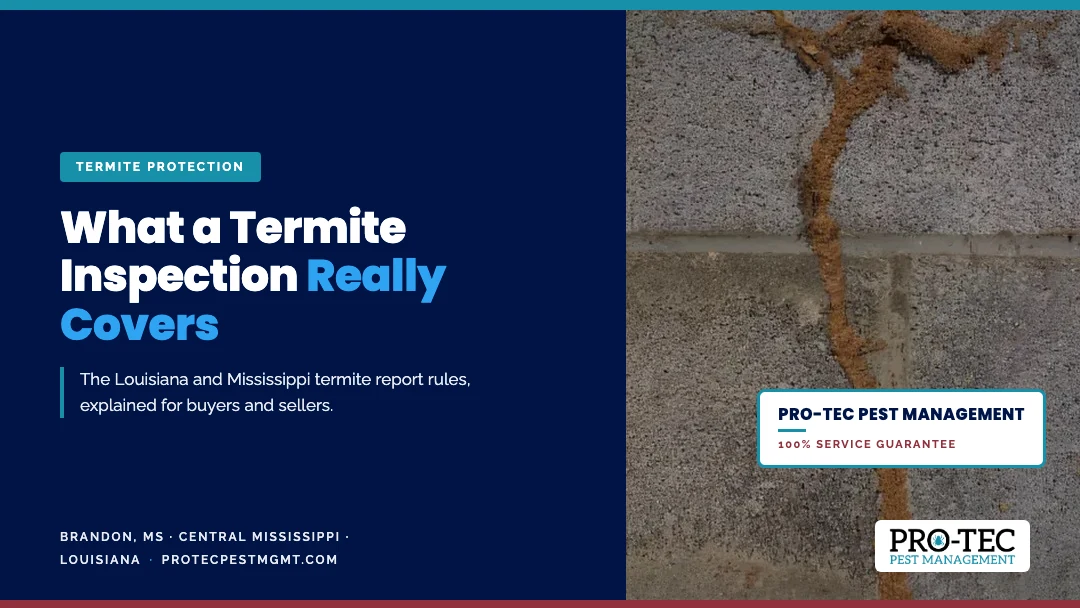
Mississippi State University Extension entomologist Dr. Blake Layton lists three major clues in the MSU Extension guide to signs of termite infestation: swarmers emerging from the structure itself, mud shelter tubes running up the foundation outside or in the crawl space, and termite damage in the building. A thorough inspection looks for all three.
Louisiana spells out where a report inspection has to go. Under the March 2026 edition of Louisiana’s structural pest control rules, LAC Title 7, Part XXV, the inspector must check all unobstructed or accessible areas. That includes bath traps with visible access, crawl spaces under raised pier homes, and attics with a permanent ladder or staircase.
The Louisiana form treats evidence broadly: live or dead insects, insect parts, shelter tubes, frass, exit holes, and damaged wood. Conditions that invite insects under the structure or within 12 inches of it also go on the report.
Mississippi’s official Wood Destroying Insect Report form, revised in October 2025, lists the conducive conditions an inspector must record. Among them are standing water, leaks, wood touching the ground, high soil against brick or siding, mulch or stumps against the house, poor ventilation, and wood rot.
The third column is the one buyers skip, so read it closely. If you have already spotted something around the house, our rundown of the warning signs that call for professional termite control explains what each one means. In a home sale, these findings go onto a legally defined document.
What a Louisiana Wood Destroying Insect Report Is, and When You Need One
This section is Louisiana law only. There, the termite report in a real estate deal is a Wood Destroying Insect Report, or WDIR, completed on state form LPCA-143 (or LPCA-143A with an arbitration clause).
Section 121 of the rules opens with this sentence: “A wood destroying insect report approved by the commission shall be issued only for inspections made to determine the presence of wood destroying insects for acts of sale or refinance of structures.”
The next line adds that a WDIR “shall not be renewable or issued for any other purposes, and shall not provide a guarantee to repair damage caused by wood destroying insects.” In plain terms:
- It is for a sale or refinance. A WDIR is not a general checkup product.
- It is not renewable. The report is tied to one inspection on one date.
- It does not promise to repair damage, including damage the report itself records.
A termite letter is easy to mistake for a warranty. The rule says it is not one.
Closing on a home soon? Termite questions are easier to sort out well before the deadline. Call the office for your state and tell us where you are in the process.
The 90-Day Guarantee Most Louisiana Buyers Do Not Know About
Louisiana’s WDIR does carry one real protection, written directly into the rule. It is narrow, so the details matter.
Section 121.B says the report “shall carry a guarantee that the property will be treated without charge should live subterranean termites covered by the report be found in any readily accessible area within 90 days from the date of inspection.” Break that sentence apart and you get four conditions:
- The clock starts on the inspection date, not the closing date.
- The trigger is live subterranean termites. The guarantee language does not mention other insects.
- The remedy is treatment without charge. It is not repair.
- The termites must turn up in a readily accessible area.
Section 101 of the same rules defines readily accessible areas as “areas that are unobstructed and that are able to be reached and entered for visible examination at the time of inspection.”
Areas hidden by walls, ceilings, floor coverings, furniture, appliances, equipment, or stored items do not count. Neither do crawl spaces and attics that are too small to enter, lack a permanent ladder or staircase, or have no decking.
If closing lands 60 days after the inspection, the buyer has about 30 days of the window left. That window only helps if the person who wrote the report was qualified to write it.
How to Tell You Are Dealing With a Licensed Inspector
Both states tie the report to a license. The check is simple in either one.
In Louisiana, the rules say no one may conduct a WDIR inspection “unless that person is properly licensed in termite control or is a certified WDIR technician.” A certified technician has to work under the supervision of a licensee. Item 4 on the LPCA-143 form is the inspector’s license number, and item 12 carries the inspector’s signature and license or registration number.
Louisiana license questions go to the LDAF Structural Pest Control Commission, which lists (225) 925-3787 as its contact number.
One promise is a red flag. Section 121.A.2 says no licensee, or anyone they employ or supervise, may tell a customer, orally or in writing, that insects found more than 90 days after the WDIR inspection will be treated at no cost or the damage repaired. If you hear that promise, the person making it is describing something the rule prohibits.
In Mississippi, Rule 117.01, last amended in 2008, of the Bureau of Plant Industry’s professional services regulations requires real estate termite inspections to be done by someone licensed for “wood destroying insect control” or a bona fide employee under direct supervision. The official form has a field for the license number.
The Mississippi inspector must also post a durable notice by the water heater, the crawl space access, or beneath the kitchen sink, giving the licensee’s name and address and the inspection date.
With the inspector checked, the last step is being clear about the limits of the report itself.
What a Termite Report Does Not Do
A termite report answers one question: what did a licensed inspector see on one day? It does not cover what happens next.
- It does not guarantee repairs. Louisiana’s §121 says so directly. Mississippi’s Rule 117.01 states that “there is no warranty, express or implied” on its official report.
- It is not a structural damage report. The Mississippi form says so, and adds that reported damage “does not imply that damage should be repaired or replaced.” For a structural opinion, it points to a qualified engineer.
- It does not cover hidden areas. The Mississippi form states it is not an opinion on areas that are enclosed or inaccessible.
- A clean report is not a clean bill of health. The MSU Extension guide notes there is always the potential for a building to harbor hidden infestations. It recommends preventive treatment and annual inspections as the best defense.
The Mississippi form also asks if the inspecting company has a current treatment contract in force and if it can transfer, and it tells the buyer to get a copy. If a contract exists, that is where ongoing coverage lives.
Ongoing protection is the job of a plan. Our guide to what a real termite plan includes walks through it, and Pro-Tec’s termite control service covers inspection and treatment for homes in both states.
Mississippi vs. Louisiana: How the Termite Report Rules Differ
Pro-Tec serves both states, so here are the two sets of rules side by side.
| Louisiana | Mississippi | |
|---|---|---|
| Official form | LPCA-143, or LPCA-143A with an arbitration clause | Mississippi Official Wood Destroying Insect Report |
| When it is used | Only for a sale or refinance | Any termite report issued in a real estate transaction |
| Who can inspect | Licensed in termite control, or a certified WDIR technician under a licensee | Licensed for wood destroying insect control, or an employee under direct supervision |
| What it records | Wood destroying insect evidence, with live insects identified | Subterranean and drywood termites, wood borer beetles, carpenter ants, carpenter bees |
| Guarantee | Free treatment for live subterranean termites found in readily accessible areas within 90 days | No warranty, express or implied |
| Repairs | The report does not guarantee repair of damage | Reported damage does not imply it should be repaired |
The biggest gap is the guarantee: Louisiana builds a 90-day treatment promise into the report, and Mississippi builds in none.
For Louisiana homes in the capital region, start with our Baton Rouge termite control team. In central Mississippi, see termite protection for Brandon homes.
Common Questions About Termite Inspections in Mississippi and Louisiana
These are the questions that come up most around a home sale in either state. Each answer names the state it applies to.
What is a wood destroying insect report?
It is the official state form a licensed inspector completes when checking a home for termites and other wood destroying insects during a real estate transaction. Louisiana uses form LPCA-143 or LPCA-143A. Mississippi uses the Mississippi Official Wood Destroying Insect Report. Both record evidence, damage, conducive conditions, and areas that could not be inspected.
Do I need a termite inspection to sell my house?
The state rules covered here govern how the report is done when one is ordered for a sale. They do not say every sale must have one. Your purchase agreement or loan program may. Mississippi’s official form, for example, notes its information is used to evaluate property for VA or HUD insured loans. Ask your agent or lender early.
How long is a termite inspection good for?
In Louisiana, a WDIR is not renewable, and its treatment guarantee runs 90 days from the inspection date. Mississippi’s Rule 117.01 does not set an expiration period for its official report. If your lender or contract has a timing requirement, ask about it before you schedule the inspection.
Does a termite report guarantee repairs?
No. Louisiana’s rule says a WDIR “shall not provide a guarantee to repair damage.” Mississippi’s rule says there is no warranty, express or implied, on its official report. In Louisiana, the only guarantee is treatment without charge for live subterranean termites found in a readily accessible area within 90 days of the inspection.
Who is allowed to do a termite inspection for a home sale?
In Louisiana, the inspector must be licensed in termite control or be a certified WDIR technician working under a licensee’s supervision. In Mississippi, the inspector must be licensed for wood destroying insect control or be an employee under a licensee’s direct supervision. Either way, the license number belongs on the form.
A termite report is a snapshot. Protection is a plan.
Pro-Tec Pest Management inspects and protects homes across Mississippi and Louisiana. Tell us if you are buying, selling, or protecting a home you already own, and we will lay out clear next steps before you commit to anything.