What Mississippi Homeowners Should Know About Termite Control Before Swarm Season
Quick Answer: Native subterranean termites begin swarming in south Mississippi as early as late February and across the rest of the state through mid-May, so the best time to have an active termite plan in place is ahead of swarm season, not after you spot winged termites indoors. By the time a swarm appears, the colony is already established and feeding. Termites cost US homeowners $6.8 billion a year in damage that standard homeowners insurance excludes.
TLDR:
- Native subterranean termites start swarming in south Mississippi as early as late February and continue through mid-May, per Mississippi State University Extension.
- The invasive Formosan subterranean termite swarms later, from late April through June, in the early evening and is strongly drawn to lights.
- Seeing a swarm means the colony is already mature and feeding. Swarmers are the result of an infestation, not the start of one.
- Termites cause $6.8 billion in property damage across the US every year, and standard homeowners insurance excludes nearly all of it.
- In Louisiana, the Formosan termite is the most destructive insect in the state, with roughly $500 million in damage a year.
- Mississippi State Extension is direct: termite control is not a do-it-yourself job, and the right move is an active contract with annual professional inspections.
- A termite plan set up ahead of swarm season gets a barrier in place before the heaviest swarm pressure of the year.
What does it take to protect a Mississippi home from termites? The honest answer is timing. Termite pressure across the Gulf South is not a summer problem you can address whenever it gets warm. It builds toward a hard deadline in early spring, when colonies that have fed quietly through winter send out their first swarmers. Pro-Tec Pest Management services homes from Brandon, Mississippi across the Jackson Metro and Rankin County and into Louisiana, and our termite calendar is built around the actual Gulf South swarm window, not a generic national one.
The pattern we see every spring is the same. The calls spike right after the first warm, rainy day, when homeowners find a pile of discarded wings on a windowsill or a swarm against a sunlit window. By then the colony has been working for months or years. Here is why a termite plan belongs on your calendar ahead of swarm season, and what that plan should actually cover for a Mississippi or Louisiana home.
Get a barrier in place before swarm season. Request a termite inspection, or call Mississippi (601) 938-0079 / Louisiana (225) 369-2783.
When Termites Swarm in Mississippi and Louisiana
The single most important date on a Mississippi termite calendar is the start of swarm season. Native subterranean termite swarmers have started appearing in late February in south Mississippi and early March further north, with the broader native swarm running from mid-February to mid-May during the day, per Mississippi State University Extension.
The invasive Formosan subterranean termite swarms on a later schedule. Mississippi State Extension places Formosan swarms from late April through June, in the early evening, and the Formosan is strongly attracted to lights. That second wave matters for Louisiana especially, where the Formosan termite is the most destructive insect in the state.
The reason the calendar drives the plan is simple. A protective treatment works best when it is already in the soil before swarmers fly. Waiting until you see a swarm means the barrier goes in after the colony has had a full season head start.
So if late February is the leading edge of native swarms, the practical window for getting a plan in place is late winter, before swarmers fly. If you are reading this mid-season and already seeing swarmers or discarded wings, the move is the same: get an inspection and treatment going now, while the colony is active.
A Swarm Is Not the Start of the Problem
The most common termite misunderstanding we hear is that a swarm is the beginning of an infestation. It is the opposite. Subterranean termite colonies only produce winged reproductive swarmers once they are mature, which can take three to five years of feeding. By the time you see them, the colony is established and has been eating.
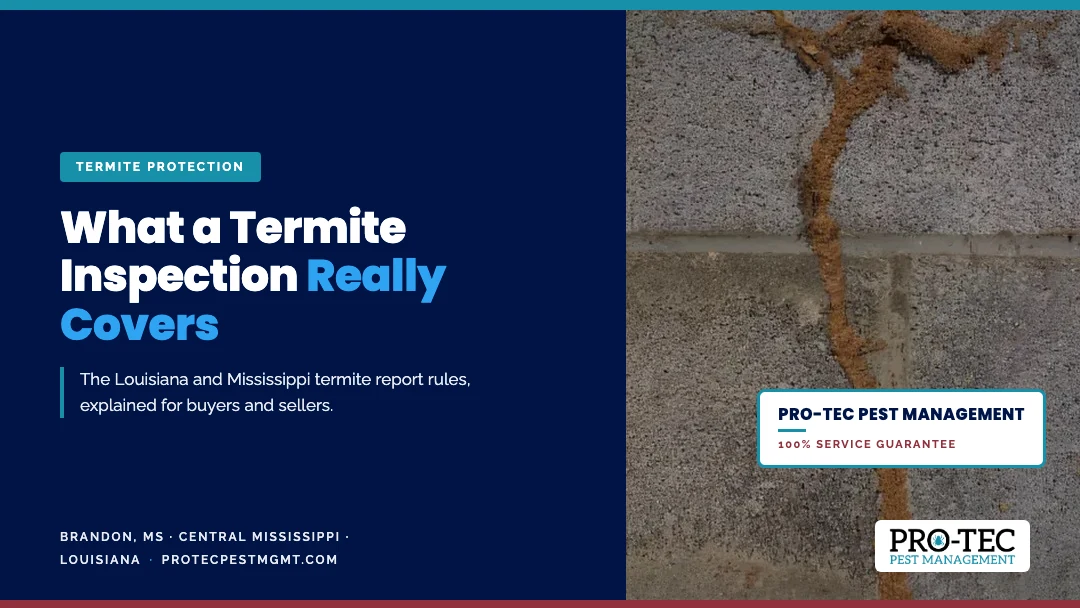
That changes how you should read a swarm. A pile of equal-length wings on a windowsill, a sunny window dotted with dark winged insects, or mud tubes running up a foundation are all signs of a colony that is already present, not a warning that one might arrive. The damage clock has been running.
This is also why a single can of store-bought spray does nothing meaningful against a real infestation. Killing the swarmers you can see leaves the colony underground untouched. Mississippi State Extension is direct on this point: termite control is not a do-it-yourself job.
If a swarm has already happened at your home, that moves the timeline up, not off the table. The next section covers why the financial stakes make a professional plan the only sensible response.
The Cost Mississippi Homeowners Carry Alone
Termites cause an estimated $6.8 billion in property damage across the United States every year, a figure the National Pest Management Association attaches to a pest most homeowners never see coming. The damage accumulates inside walls and under floors before any visible sign appears.
The part that catches homeowners off guard is the insurance gap. Standard HO-3 homeowners policies exclude damage from insects and vermin, treating termite damage as a preventable maintenance issue rather than a sudden covered peril, per Insurify’s homeowners insurance reference. There is no standard policy that pays to repair termite-eaten framing.
In Louisiana the regional stakes climb higher. The LSU AgCenter reports the Formosan subterranean termite as the most destructive insect in the state, responsible for roughly $500 million in damage a year, with colonies that can reach into the millions of individuals.
Put those two facts together and the math is plain. The most expensive pest in the Gulf South is also the one your insurance will not cover. That leaves prevention as the only real protection, which is exactly what a termite plan provides.
What a Real Termite Plan Includes
A termite plan is not a single spray. Mississippi State Extension’s guidance is to maintain an active contract with a reputable pest management company that includes annual professional inspections and a soil-based treatment, either a liquid barrier or bait stations. The plan combines a protective treatment with ongoing monitoring so a new colony gets caught early.
The core pieces of a professional termite plan break down like this.
| Plan component | What it does | Why it matters in Mississippi |
|---|---|---|
| Annual professional inspection | Trained check of foundation, crawlspace, and wood-soil contact for mud tubes and damage | Catches activity before swarm season and documents the home’s status |
| Soil treatment (liquid barrier or bait) | Treats the soil around the structure to stop subterranean termites reaching the wood | Native and Formosan termites both attack from the soil |
| Conducive-condition correction | Identifies wood-to-soil contact, moisture, and other invitations | Removes the conditions that draw termites back |
| Ongoing monitoring and records | Tracks the home over time with a documented service history | Useful at resale and for keeping coverage active |
The takeaway from that table is that inspection and treatment work together. One without the other leaves a gap, which is why a plan, rather than a one-time call, is the standard a Mississippi home needs.
To talk through what a plan would look like at your address, request a termite inspection or call Mississippi (601) 938-0079 or Louisiana (225) 369-2783.
Liquid Barrier or Bait Stations: How Treatments Differ
Both main soil-treatment approaches are recognized by Mississippi State Extension, and the right one depends on the property, not a one-size answer. A liquid barrier treats the soil around the foundation to create a treated zone termites must cross. Bait stations are placed in the ground around the home and use the termites’ own foraging to carry the active ingredient back to the colony.
Neither is automatically better. Soil type, slab construction, existing landscaping, moisture conditions, and the level of Formosan pressure all influence the call. A professional inspection is what determines which approach fits a given Mississippi or Louisiana home.
What both approaches share is that they belong in the ground before swarm season peaks, and both need professional placement to work as intended. That reinforces the same point: the value is in a planned, inspection-led program rather than a reactive purchase after a swarm.
Why Pro-Tec Builds Termite Protection Around the Gulf South Calendar
Pro-Tec Pest Management’s termite work is built around the actual Mississippi and Louisiana swarm window. We inspect ahead of native swarm season, watch for the later Formosan wave that hits Louisiana hardest, and match the treatment approach to the property rather than defaulting to one method everywhere.
Termite protection is a regulated service in both states, with its own inspection requirements and warranty terms, which is exactly why it sits apart from a general pest plan. Our approach pairs the termite program with the same evidence-based, proactive-not-reactive philosophy behind our broader 365 protection model. We document what we find and treat what is actually there.
The reassuring part for a homeowner is that getting ahead of termites is straightforward once the plan is set. The hard part is timing, and that is the part a plan solves. From there, the questions below cover what Mississippi and Louisiana homeowners ask us most.
Common Questions About Termite Control in Mississippi and Louisiana
These are the questions homeowners ask us most as swarm season approaches. The sections above explain the timing and the stakes. The answers below cover the practical details of getting protected.
When do termites start swarming in Mississippi?
Native subterranean termites begin swarming in south Mississippi as early as late February and early March further north, with the broader native swarm running through mid-May, per Mississippi State University Extension. The invasive Formosan termite swarms later, from late April through June. A protective plan works best when it is in place before the first native swarms.
When should I set up a termite plan in Mississippi?
Ideally in late winter, before native subterranean termites start swarming in late February, since a soil treatment protects best when it is already in place before swarmers fly. That said, protection helps any time of year. If you are mid-season and already seeing swarmers, set up an inspection and treatment now, because the colony is active and feeding.
Does seeing a termite swarm mean my house is already infested?
A swarm means a mature colony is present nearby, since subterranean colonies only produce winged swarmers after years of feeding. Finding swarmers or discarded wings indoors is a strong sign of an established colony rather than a brand-new one, which is why a professional inspection is the right next step.
Does homeowners insurance cover termite damage?
Standard HO-3 homeowners insurance policies exclude termite damage, treating it as a preventable maintenance issue rather than a covered peril. There is no typical policy that pays to repair termite-damaged framing, which is why an active termite plan is effectively the only protection most homeowners have against the cost.
What is the difference between a liquid barrier and bait stations?
A liquid barrier treats the soil around the foundation so termites cannot reach the wood, while bait stations are placed in the ground and use the termites’ foraging to carry the active ingredient back to the colony. Both are professional soil treatments, and which one fits depends on the property. An inspection determines the right approach.
Are Formosan termites a concern in Mississippi and Louisiana?
Yes, especially in Louisiana, where the LSU AgCenter calls the Formosan subterranean termite the most destructive insect in the state. Formosan colonies are far larger and more aggressive than native colonies and swarm later in spring. A termite plan in the Gulf South accounts for both native and Formosan pressure.
Can I treat termites myself?
Mississippi State University Extension is direct that termite control is not a do-it-yourself job. Store-bought sprays kill visible swarmers but leave the underground colony untouched, and proper soil treatments require professional placement to work. An active contract with annual inspections is the standard recommendation.
Get a termite plan in place before the first swarm.
Pro-Tec Pest Management inspects Mississippi and Louisiana homes ahead of swarm season, matches the right soil treatment to your property, and backs it with annual monitoring and documented service records. We treat what is actually there, before the damage adds up.
Call Mississippi (601) 938-0079 or Louisiana (225) 369-2783 to talk through your property, or request a free inspection online.