How a Quarterly Pest Control Visit Works in Mississippi and Louisiana
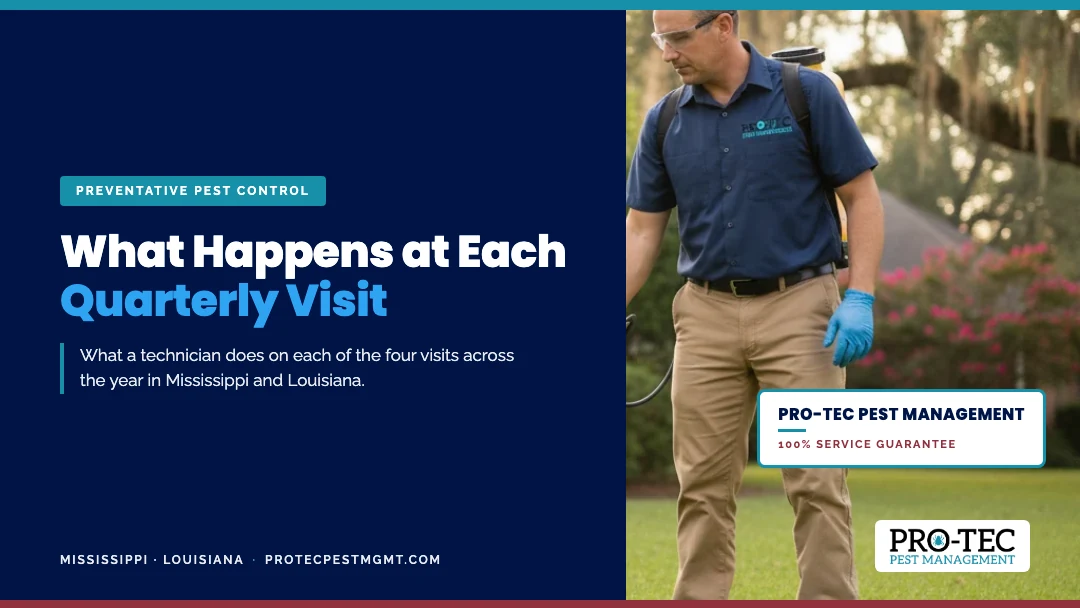
A quarterly visit is a service performed every three months. On each one, a technician inspects your home, treats the exterior barrier, clears webs and nests, checks entry points, and targets the pests active that season. Each of the four visits is timed to a different threat: termites and ants in spring, mosquitoes and fire ants in summer, and rodents in fall and winter. The work follows a professional framework, not a set spray.
TLDR:
- A quarterly plan means four scheduled visits a year, one every three months.
- Each visit follows the EPA’s Integrated Pest Management steps: inspect, identify, prevent, then treat.
- The technician treats the exterior barrier, clears webs and wasp nests, and checks entry points every visit.
- Interior treatment is done on request or when the inspection finds activity.
- Timing is the point: spring targets termites and ants, summer targets mosquitoes and fire ants, fall and winter target rodents.
- Pests here breed fast and stay active year-round, so one annual treatment leaves long gaps.
- Between visits, you get callbacks at no extra charge if pests show up.
The Gulf South does not get a real pest offseason. Warm, humid weather across Mississippi and Louisiana keeps insects and rodents moving most of the year, and the region sits in the path of the most destructive termites in the country. A single treatment in January is worn out and irrelevant by the time termites swarm in May. A quarterly plan keeps protection current as the threat changes shape through the seasons.
What Every Quarterly Visit Includes
Every visit follows the same professional structure before the season-specific work begins. That structure is Integrated Pest Management, and it is what separates a service plan from a can of spray.
The EPA’s Integrated Pest Management approach runs as a four-step decision process: set thresholds, monitor and identify what is actually present, prevent entry, then treat with the least-risk method that solves the problem. A technician works that same order on your property.
Here is what that looks like on the ground at each visit:
- Inspection and monitoring. A walk of the exterior and problem areas to read what pressure the home is under right now.
- Identification. Confirming which pests are active, since the treatment for ants is not the treatment for rodents.
- Prevention and exclusion. Checking entry points, gaps, and moisture that let pests in, and clearing spider webs and wasp nests from the eaves and structure.
- Targeted treatment. A fresh exterior barrier plus interior treatment on request or wherever the inspection finds activity.
The interior is treated when you ask or when the inspection calls for it, so a quiet quarter does not mean an unnecessary indoor application. That restraint is the IPM principle at work.
Why Every Three Months, Not Once a Year
The cadence is not arbitrary. It is built around how fast pests reproduce and how quickly conditions change in this climate.
Consider the German cockroach. A single mated female can produce thousands of offspring in under a year, with each egg case yielding dozens of young and three to six generations stacking up annually, per University of Kentucky entomology data. A gap of twelve months between treatments is more than enough time for a few survivors to rebuild into a full infestation.
Seasonal timing matters just as much. The LSU AgCenter recommends baiting fire ants in April and again in October, twice a year, because a single application does not hold through Louisiana’s long warm season. Professional plans follow the same logic across every pest: treat ahead of each wave, then monitor and adjust. National forecasting backs this up, with the 2026 NPMA Bug Barometer flagging termites, mosquitoes, and ants surging early across the Southeast.
Booking your plan is straightforward. You can schedule a pest control appointment online, or reach a local office directly in Mississippi at (601) 938-0079 or Louisiana at (225) 369-2783.
The Spring Visit: Termite and Ant Season
The spring visit is the most important one for structural protection. Warming, humid weather wakes up the pests that do the most expensive damage.
Subterranean termites swarm in spring across the Gulf South. Native Eastern subterranean termites swarm from mid-February through mid-May, and the invasive Formosan termite follows from late April into June, according to Mississippi State University Extension. The Formosan termite is the most destructive structural pest in Louisiana and is now established in roughly 42 of the state’s 64 parishes, per the LSU AgCenter.
The spring visit puts eyes on swarm evidence, mud tubes, and conducive moisture before a colony gets a foothold. Ants and carpenter ants pick up in the same window, so the exterior barrier and entry-point work carry extra weight this quarter.
The Summer Visit: Mosquitoes, Fire Ants, and Wasps
Summer is peak activity for the pests people notice most in the yard. Heat and afternoon rain drive breeding.
Mosquitoes and fire ants flourish in Louisiana’s warm, wet summer, which is why the LSU AgCenter schedules its second fire ant baiting for this stretch of the year. Wasp and hornet nests reach full size around structures and eaves. The summer visit focuses on standing-water sources that breed mosquitoes, active fire ant mounds, and nest removal before a nest becomes a stinging hazard by the door.
This is also when a fresh exterior barrier earns its keep, since the pests are pushing hardest against the home from outside.
The Fall Visit: Rodent Exclusion Season
Fall flips the focus from the yard to the structure. As nights cool, the pressure moves indoors.
Mice leave their outdoor nests and move into homes and buildings looking for warmth as temperatures drop, per University of Georgia Cooperative Extension. The fall visit leans into exclusion: sealing gaps, checking foundation and utility penetrations, and setting monitoring where rodents are likely to enter. The CDC’s own rodent guidance follows a seal-up, trap-up, clean-up model, and fall is the season to get ahead of it before the first cold snap pushes rodents inside for good.
Catching entry points in September and October is far easier than evicting an established population in January.
The Winter Visit: Indoor Pests and Rodents
Winter does not shut pests off in this region. It concentrates them indoors, in the warm and the dry.
Rodents do not hibernate. They stay active in heated structures through winter, and CDC guidance treats indoor shelter-seeking as a cold-weather constant rather than an exception, per the CDC’s rodent control resources. German cockroaches thrive indoors in heated buildings year-round, sustaining activity through the coldest months, again per University of Kentucky entomology. The winter visit keeps interior monitoring current, maintains rodent control, and treats indoor hot spots like kitchens and utility rooms where roaches shelter.
By the time the winter visit wraps, spring termite season is already on the horizon, and the cycle starts again.
Common Questions About Quarterly Pest Control in MS and LA
These are the questions homeowners across Mississippi and Louisiana ask before starting a quarterly plan. If you are weighing a plan against one-off treatments, the answers below cover what changes.
How often is a quarterly pest control visit?
A quarterly plan means four visits a year, one roughly every three months. Each visit is scheduled ahead of the season’s main pest pressure, so treatment lands before an infestation builds rather than after.
Do I need to be home for the visit?
Not for the exterior work, which is most of a routine visit. You only need to be present when you want interior treatment or when the inspection finds indoor activity that needs access. Your technician will coordinate interior visits with you.
What if pests show up between visits?
Reputable quarterly plans include callbacks between scheduled visits at no additional charge. If you see activity a month after a visit, you call and a technician returns to re-treat, since keeping the problem solved is the point of the plan.
Is quarterly service enough, or do I need monthly?
For most homes in Mississippi and Louisiana, quarterly service paired with between-visit callbacks handles general pests. Heavy infestations, commercial kitchens, or specific issues like bed bugs or an active termite colony may call for a targeted plan on a different schedule.
Does quarterly pest control cover termites?
A general quarterly plan monitors for termite evidence during each inspection, but termite protection is usually a separate specialized service given how much damage they cause. The spring visit is when a technician looks hardest for swarm signs and mud tubes and flags when a dedicated termite plan is needed.
Why not just treat once a year and save money?
Pests here breed fast and stay active most of the year, so a single annual treatment leaves long gaps where populations rebuild. A German cockroach line can explode in months, and termites swarm every spring. Quarterly timing keeps protection current instead of expired.
Ready for pest protection that keeps up with the season? A Pro-Tec quarterly plan puts a trained technician on your home four times a year, timed to the pests that matter most in Mississippi and Louisiana. Explore our pest control services or book a visit below.