Restaurant Receiving and Storage: Where Pest Exclusion Starts
Quick Answer: Pest exclusion in a restaurant starts at the receiving door. Keep outer doors shut, inspect every delivery for pests and damaged packaging, and check cold food temperatures before you sign. Then store food at least 6 inches off the floor, leave room to clean behind shelving, seal opened dry goods, and use the oldest stock first.
TLDR:
- The FDA Food Code tells restaurants to routinely inspect incoming shipments of food and supplies for pests.
- Outer doors should be solid, self-closing, and tight-fitting, so a propped receiving door works against you.
- Packages should arrive intact, and refrigerated TCS food should arrive at 41°F or below.
- Food belongs at least 6 inches off the floor, with room behind shelving to inspect and clean.
- Opened bulk food goes in a lidded, insect- and rodent-proof container, and the oldest stock gets used first.
- Droppings, gnaw holes, silk webbing, and small round holes in grains are the early signs to train staff on.
We service restaurant kitchens on both sides of the state line, from Brandon and Meridian in Mississippi to Baton Rouge, Denham Springs, and Walker in Louisiana. In a Gulf South kitchen, the back door opens many times a day for deliveries and trash runs, and that traffic gives pests steady chances to get in.
This guide walks through the receiving door and the dry storage room, the two places where a little routine keeps a lot of pests out. It is general guidance, not legal advice. Your local health department has the final word.
Want a second set of eyes on your receiving and storage areas? Pro-Tec Pest Management provides recurring restaurant pest control across Mississippi and Louisiana, starting with an inspection that looks for entry points, nesting zones, and sanitation risks.
Why the Receiving Door Matters for Pest Control
Most kitchen pest plans focus on the cook line and the drains. The receiving door deserves the same attention, because it is where outside goods first meet your building.
The FDA writes it into the rules. Section 6-501.111 of the FDA 2022 Food Code says the premises must be kept free of pests, starting with “routinely inspecting incoming shipments of food and supplies.” Routine inspection of the premises and eliminating harborage come next on the same list.
That model code applies in Mississippi. The Mississippi State Department of Health lists the 2022 FDA Food Code as the code that applies throughout the state, with additional state regulations on top. In Louisiana, the Department of Health’s food safety checklist points operators to the state sanitary code for retail food establishments.
Insects can also arrive already inside the product. The LSU AgCenter’s 2021 guide to stored product pests explains that infestations that seem to appear overnight were often brought in inside an infested product. That is why the check happens at the door, before the case reaches a shelf.
A Six-Step Receiving-Door Pest Check
A good receiving routine takes a few minutes per delivery. The six checks below come straight from the Food Code and the Louisiana Department of Health’s own checklist for food service operators.
Keep the door shut. Section 6-202.15 of the Food Code calls for solid, self-closing, tight-fitting doors on outer openings. The Louisiana Department of Health food safety checklist, posted as a 2017 file, adds that outer openings should be tightly sealed or screened with 16 mesh screen. A door propped open for a long unload undoes both.
Check the packaging. Section 3-202.15 says food packages must be in good condition and protect their contents. Torn bags, crushed cases, and chewed corners are worth a closer look before you sign.
Check cold food on arrival. Under section 3-202.11, refrigerated time/temperature control for safety (TCS) food should arrive at 41°F or below, and food labeled and shipped frozen should arrive frozen. Temperature is a food safety check more than a pest check, but it happens at the same moment, so build both into one routine.
Confirm the source. The LDH checklist says food should come from approved sources and carry approved labels.
| Receiving Check | What to Look For | Where It Comes From |
|---|---|---|
| Door | Closed between drops, no gaps or daylight | FDA Food Code 6-202.15 |
| Shipment | Live pests, droppings, or other signs | FDA Food Code 6-501.111 |
| Packaging | Intact, not torn, crushed, or chewed | FDA Food Code 3-202.15 |
| Cold food | 41°F or below; frozen arrives frozen | FDA Food Code 3-202.11 |
| Source | Approved source and approved labels | LDH Food Safety Checklist |
| Put-away | Off the floor, into storage promptly | FDA Food Code 3-305.11 |
If a delivery fails a check, set it apart from your stock and talk to the supplier before it goes on a shelf. Note what you found and when, so your pest provider sees the same picture you do.
How to Set Up Dry Storage for Pest Exclusion
Once a delivery clears the door, the storage room decides if pests find a place to settle. Floor clearance, wall clearance, sealed containers, and rotation all work together here.
Store food off the floor. Section 3-305.11 of the Food Code says food must be stored in a clean, dry location, away from splash and dust, and at least 6 inches above the floor. The LDH checklist repeats the 6-inch rule for food, equipment, utensils, and disposable items. The Code allows exceptions for packaged food on approved case lot equipment and for canned or bottled goods on a clean, dry floor.
Leave room behind the shelves. The Food Code section above sets a floor height, not a wall distance. Louisiana’s rule for food storage warehouses, in the April 2013 edition of the state sanitary code, calls for food at least 18 inches from walls “to permit inspection and cleaning.” That rule is written for warehouses, not restaurants, but the reason behind it carries over: you cannot inspect a gap you cannot reach.
The 2026 edition of MSU Extension’s guide to household insect pests shows why. It notes that Indian meal moth pupae are often found where the wall meets the ceiling or along the undersides of shelves where they meet the wall.
Seal what you open. The LDH checklist says that once a bulk food package is opened, the food should be stored in an insect- and rodent-proof container with a lid. The bulk containers should be labeled with the common name of the product.
Keep food out of the wrong rooms. Section 3-305.12 lists places food may not be stored at all: locker rooms, toilet rooms, dressing rooms, garbage rooms, and mechanical rooms. It also rules out storage under unshielded sewer lines, under leaking water lines, and under open stairwells.
Need help finding the weak spots in your storage room? Our restaurant pest control service pairs monthly or quarterly maintenance visits with full documentation, so recommendations are written down and easy to follow up on.
First In, First Out Keeps Stock From Becoming Harborage
Stock rotation is usually framed as a quality and food safety habit. It is also a pest habit, because forgotten product is where pantry insects get started.
Annex 5 of the 2022 Food Code describes First-In-First-Out (FIFO) as using the first batch placed in storage first, and says the concept encourages product rotation. Louisiana’s warehouse rule cited above also says stock “shall be rotated on a ‘first in, first out’ basis.”
The pest connection comes from extension research. The MSU Extension insect guide notes that stored food pest infestations most commonly start in dry food products that were opened and then forgotten or left in storage a long time. The Food Code also asks for premises free of unneeded items and litter under section 6-501.114, which keeps clutter from turning into harborage.
In practice, that looks like a few simple rules:
- Date cases when they arrive, so the oldest product is obvious.
- Move older stock to the front when a new delivery is put away.
- Break down empty boxes and get them out of storage the same day.
- Clear out discontinued items instead of letting them sit on a back shelf.
Pest Signs to Train Staff to Spot
Your staff sees the storage room every day, and a pest technician sees it on a schedule. A short list of signs helps the people who are there daily catch problems early.
Rodents. A 2021 MSU Extension safety talk on mice and rats lists squeaking, gnawing, or scratching noises in walls and ceilings, holes chewed through walls and floors, burrow holes around buildings, and stale smells from hidden areas. It also notes that rodents leave droppings and urine stains that can contaminate food.
Stored-product insects. The MSU Extension guide describes Indian meal moth larvae producing silk webbing in grain products and Angoumois grain moths leaving small round exit holes in kernels. LSU AgCenter adds that these pests often turn up in clusters along one part of a shelf, and that open or torn packaging is where to start looking.
Dead pests in traps. Section 6-501.112 of the Food Code says dead or trapped pests should be removed often enough that they do not pile up, decompose, or attract more pests.
When staff spot a sign, the next steps are simple: note the date and the location, set the affected product aside, and tell your pest provider. If rodents are the issue, our rodent control service covers entry points as well as activity inside.
What Pro-Tec Does on a Restaurant Visit
Receiving and storage habits work best alongside a professional program. Here is how our commercial kitchen pest control program works.
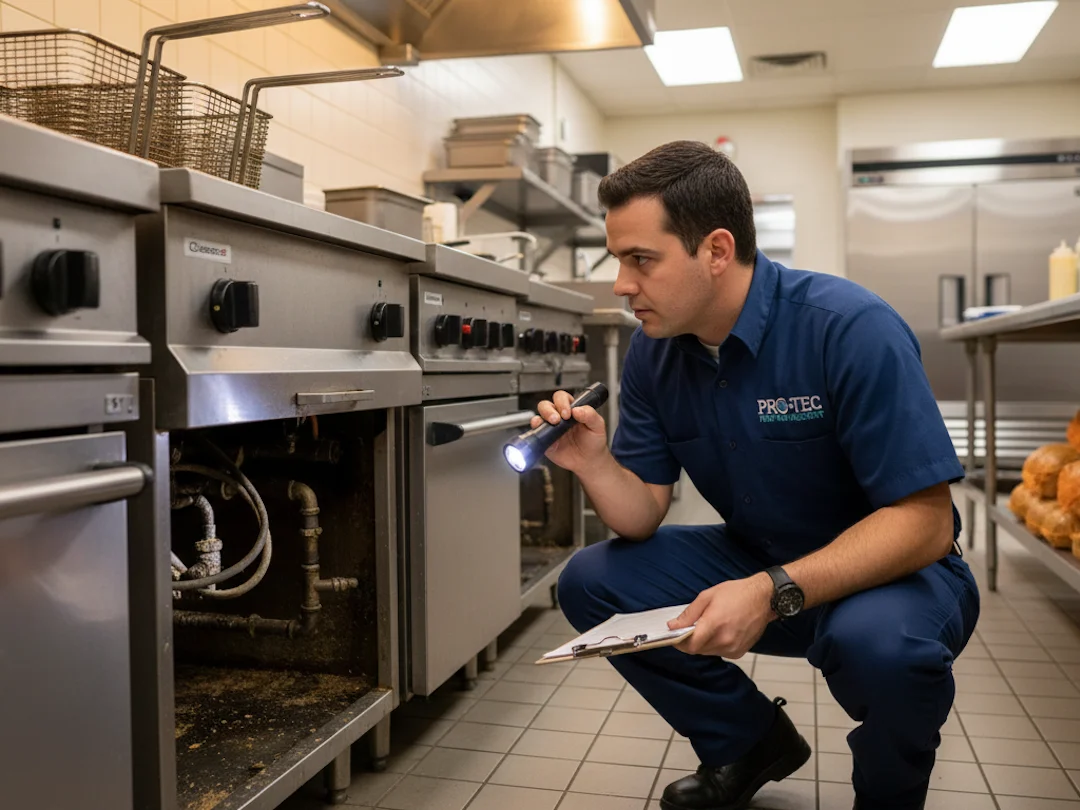
- Inspection and risk assessment. We identify entry points, nesting zones, and sanitation risks.
- Custom treatment plan. Scheduling and product selection are tailored to your kitchen layout and hours.
- Ongoing monitoring. Monthly or quarterly maintenance visits with full documentation.
- Dated service reports. After every visit, we leave a report showing what was inspected, what was treated, and what we recommend correcting, ready for health inspectors and corporate audits.
Our technicians are licensed, and the company is insured. Stored-product pests are on the list of kitchen pests we treat, along with roaches, ants, rodents, flies, and gnats.
Keep each report in your pest log. Our guide to why verified restaurant pest control logs matter covers who reads that log and what makes it hold up. For more on the team behind the reports, see Pro-Tec’s background and service history.
Common Questions About Restaurant Receiving and Storage Pest Control
These are the questions restaurant owners and kitchen managers in Mississippi and Louisiana ask about deliveries, dry storage, and keeping pests out of both.
How far off the floor should restaurant food be stored?
At least 6 inches. Section 3-305.11 of the FDA Food Code sets that height, and the Louisiana Department of Health checklist repeats it. The Code allows exceptions for packaged food on approved case lot equipment, and for canned or bottled food on a clean, dry floor. Check your local health department for any added rules.
How far from the wall should food storage shelves be?
The Food Code storage section sets a floor height, not a wall distance. Louisiana’s rule for food storage warehouses calls for 18 inches from walls, so the space can be inspected and cleaned. Restaurants are not warehouses, so ask your health department, but leave enough room to see and clean behind every unit.
What should staff check when a delivery arrives?
Look for live pests, droppings, and damaged or chewed packaging. Confirm refrigerated TCS food arrives at 41°F or below and frozen food arrives frozen. Make sure the food comes from an approved source with approved labels. Keep the receiving door closed between drops, then move stock into storage and off the floor.
What are the signs of pests in dry storage?
For rodents, look for droppings, urine stains, holes chewed in walls or floors, gnawing noises, and stale smells. For pantry insects, look for silk webbing in grain products, small round holes in grains, small moths flying nearby, and clusters on one part of a shelf. Report any sign to your pest provider.
Does Pro-Tec look at receiving and storage areas?
Our restaurant service starts with an inspection and risk assessment that identifies entry points, nesting zones, and sanitation risks. After each visit, we leave a dated service report showing what was inspected, what was treated, and what we recommend correcting. If receiving or storage is a concern, tell your technician when you book.
Keep pests on the outside of your receiving door. Pro-Tec Pest Management serves restaurants across Mississippi and Louisiana with recurring visits and a dated service report every time. No surprises, clear next steps.