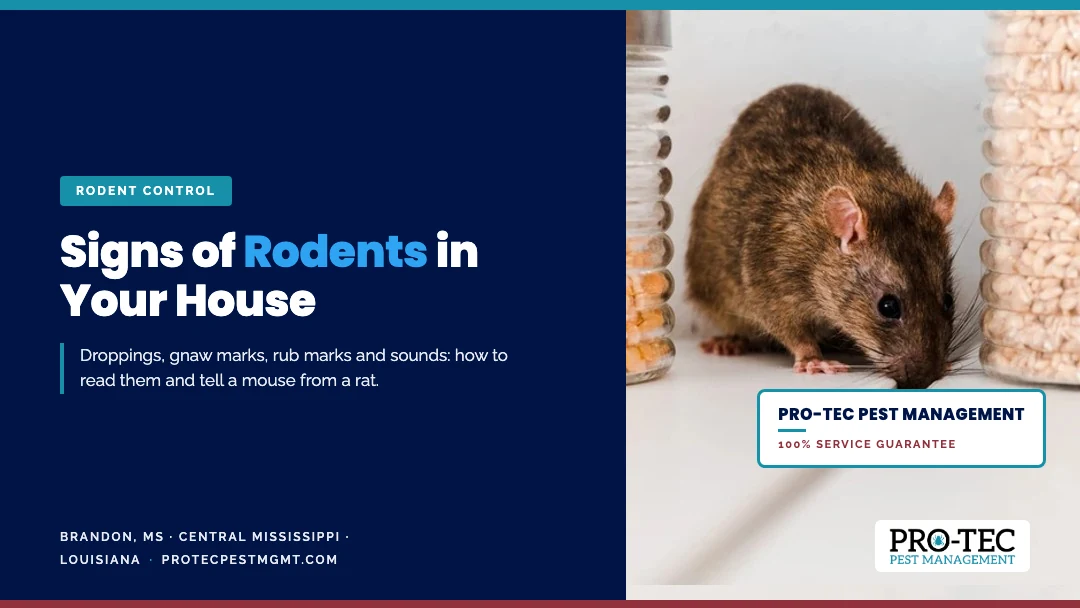

Why Do Mice Keep Coming Back After Trapping?
Quick answer: Traps remove the mice already inside, but they do nothing about the openings that let new mice in or the food and shelter that keep them there. University of California pest experts call trapping a great first step, then say it must be combined with sanitation and exclusion. Until the gaps are sealed, the house keeps refilling.
TLDR:
- Traps are a first step. They thin out the mice you have right now.
- Mice breed fast. One female can have 5 to 10 litters in a year.
- Open gaps refill the house. Any opening larger than 1/4 inch is a way in.
- Steel wool is temporary. Lasting seals use metal or concrete.
- Food and clutter keep them comfortable. Take those away and fewer survive.
- Too few traps is a common mistake. Spacing and placement matter.
Cooler weather pushes mice toward warm, sheltered spots, and Mississippi and Louisiana homes give them plenty. Most people respond the same way: set a few traps, catch a mouse or two, and call it done. Then the scratching starts again a few weeks later. Our Mississippi rodent prevention guide covers keeping mice out from the start. This guide explains why the trap-only approach keeps coming up short.
Catching mice, but they keep coming back? We find the entry points, not just the mice.
Traps Remove the Mice You Have, Not the Way They Got In
A trap answers one question: how do I get rid of this mouse? It does not answer how the mouse got in, or what keeps drawing more of them inside.
The University of California’s House Mouse Pest Notes, revised in July 2025, puts it plainly: “There is no simple and easy fix for controlling house mice.” Trapping, it says, “works well and is a great first step.” But those tools “must be combined with preventive measures like sanitation” and “exclusion to prevent entry into and movement within a structure.”
The CDC’s rodent control guidance lands in the same place. It splits the job into three parts: trap up, seal up, and clean up. Trapping is one of the three, not the whole plan.
How Fast Can a Few Mice Turn Into a Lot of Mice?
Faster than most traps can keep up with. House mice breed year-round, and the numbers stack quickly.
Per the UC Pest Notes on house mice, a female house mouse may have 5 to 10 litters in a single year, with about 5 or 6 pups in each. Her young can breed 5 to 6 weeks after birth. Run those figures and one female can produce roughly 25 to 60 young in a year, before any of her young start breeding themselves.
That is why catching two or three mice rarely ends it. If a few are still inside, or new ones can still get in, the population rebuilds while the traps sit empty.
Open Gaps Keep Refilling the House
This is the part trapping cannot touch. As long as there is a way in, new mice will find it.
The UC Pest Notes calls exclusion “the most successful and permanent form of house mouse control” and says to eliminate “all gaps and openings larger than 1/4 inch.” That is about the width of a pencil. Common spots include gaps around plumbing and utility lines, foundation cracks, vents, and doors that do not seal at the bottom. Our walk-through of where mice actually get in shows how to check each one.
What you seal with matters too. Steel wool pads “make good temporary plugs but may rust over time.” Lasting seals use metal or concrete. Plastic screening, rubber, vinyl, expanding foam, and wood are all listed as ineffective, because mice chew through them.
The left side is the loop most homeowners get stuck in. The right side is how the problem actually ends.
Not sure where they are getting in? Our technicians check the whole house, from the foundation to the roofline.
Food and Shelter Keep Them Comfortable
Mice need very little to get by. A pantry, a bag of pet food, or a cluttered garage gives them everything they need.
The CDC says the best way to prevent an infestation is to remove food sources, water, and items that provide shelter. The UC Pest Notes adds an honest caveat: good sanitation “will seldom completely control house mice,” but poor sanitation “can attract them and will permit them to thrive in greater numbers.”
A few changes go a long way. Store dry food and pet food in sealed hard containers. Clear clutter from garages, attics, and storage rooms. Keep stacked boxes off the floor and away from walls. If mice have few places to hide and nest, fewer of them survive.
Common Trapping Mistakes That Leave Mice Behind
Even when trapping is the right move, the way traps are set decides how well they work. These are the mistakes we see most.
- Too few traps. The UC Pest Notes says to space traps no more than about 10 feet apart where mice are active.
- Single traps instead of pairs. Pairs set 1 to 2 inches apart catch mice that jump over obstacles.
- Leaning on glue boards. Adult mice can often detect and avoid the glue, so glue boards tend to catch mostly young mice.
- Not checking traps often. Traps need frequent checks, and caught mice need to be removed.
- Stopping at the first catch. One mouse in a trap usually means more nearby.
When Is a Rodent Problem Bigger Than Traps Can Handle?
Some signs say the problem has moved past what traps can fix on their own.
You keep catching mice week after week. Fresh droppings show up after you clean an area, which is the test in our guide to the signs of rodents in your house. You hear movement in the attic or walls at night. Or you have sealed what you can find, and they still get in. At that point the entry points tend to be somewhere you cannot easily see or reach.
How Pro-Tec Handles a Rodent Problem
We treat the cause, not just the mice in the traps. That starts with finding how they are getting in.
Our rodent control service begins with an inspection to locate entry points, nesting areas, and the conditions drawing rodents in. From there, we build a plan for your home that removes the rodents inside and helps keep new ones out. We serve homeowners across Central Mississippi and South Louisiana, with rodent control in Brandon, Meridian, Walker, Denham Springs, and Baton Rouge.
Common Questions About Mouse Traps and Rodent Control
These are the questions homeowners ask us most when traps are not getting the job done.
Why do I keep catching mice in my traps?
Usually because mice are still getting in, or a population is still breeding inside. A female house mouse can have 5 to 10 litters a year, so a few survivors rebuild fast. Steady catches mean the entry points are still open and need to be found and sealed.
Are glue traps or snap traps better for mice?
The UC Pest Notes covers both and points out a drawback with glue boards: adult mice can often detect and avoid the glue, so they tend to catch mostly young mice. Whichever you use, place enough of them, set them where mice travel, and check them often.
How many mouse traps should I set?
More than most people expect. The UC Pest Notes says to space traps no more than about 10 feet apart where mice are active, and pairs set 1 to 2 inches apart help catch mice that jump over obstacles. Two or three traps for a whole house is rarely enough.
What size hole can a mouse fit through?
Any gap or opening larger than 1/4 inch, about the width of a pencil, according to University of California pest research. That is why sealing small gaps around pipes, vents, and doors matters as much as the traps do.
What should I use to seal mouse holes?
Metal or concrete for a lasting seal. Steel wool works as a temporary plug but can rust over time. The UC Pest Notes lists plastic screening, rubber, vinyl, expanding foam, and wood as ineffective, because mice can chew through them.
Can I get rid of mice with traps alone?
Sometimes, if only a few mice are inside and nothing new can get in. In most homes, traps need to be paired with sealing entry points and removing food and shelter. Both the CDC and the University of California treat trapping as one part of a larger plan.
Ready to stop resetting traps? We will find where they are getting in and put a plan in place to keep them out.