
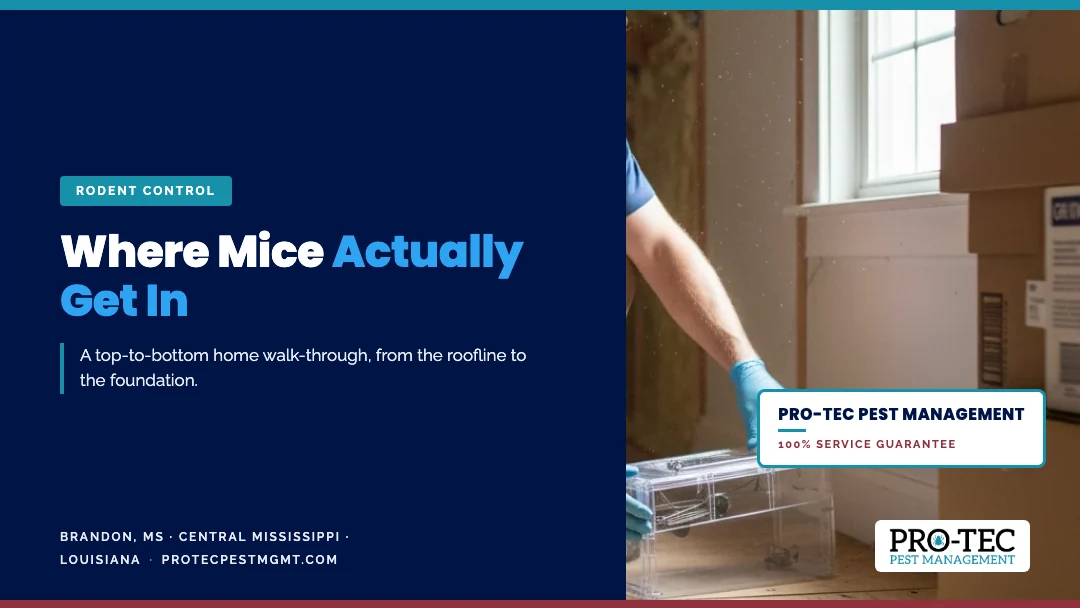
Find the Gaps Before the Mice Do
Mice and rats get into Mississippi and Louisiana homes through predictable points: gaps around utility lines, worn door sweeps, foundation cracks, unscreened vents, and roofline openings. A mouse needs only a quarter-inch gap, the width of a pencil. This walk-through takes you around the house, top to bottom, so you can find and seal every one.
TLDR:
- A mouse fits through a quarter-inch gap; a young rat needs about half an inch.
- Roof rats enter high at the soffits and roofline; Norway rats and mice enter low at the foundation and doors.
- Walk the exterior first: utility penetrations, doors, vents, foundation, and roofline.
- Then check the interior travel routes: under sinks, behind appliances, the pantry, the garage, and the attic.
- Seal with steel wool, hardware cloth, or sheet metal, never plastic, foam, or caulk alone.
- Active signs or high roofline gaps are the point to bring in a professional.
Most homeowners go looking for a hole and find nothing, then assume the mice are getting in by magic. They are not. They are using gaps you walk past every day. Once you know the specific spots and how small an opening counts, the entry points stop hiding. Here is the walk-through, in the order a rodent would use your house.
First, the Pencil Test
Before you start, calibrate your eye. The CDC notes a mouse can fit through a gap about a quarter inch wide, roughly the diameter of a pencil. Per the UC IPM program, a young rat needs only about half an inch. So you are not hunting for holes. You are hunting for gaps a pencil would fit into. Carry one and test as you go.
Start Outside: The Exterior Walk-Through
Walk the perimeter slowly and look at the building the way a rodent does, from the ground up and then to the roof. Roof rats are climbers that enter high, while Norway rats and mice work the ground level, so the whole envelope matters.
- Utility penetrations: where pipes, gas lines, cables, and AC lines enter the wall. These are the most common gaps of all.
- Doors: garage and back doors especially. Look for daylight under the door or a worn, gapped sweep.
- Foundation: cracks, gaps along the sill plate, and openings where the slab meets the wall.
- Vents and weep holes: dryer vents, crawlspace and attic vents, and brick weep holes without proper screening.
- Roofline: soffits, eaves, gaps where the roof meets the wall, and any spot a tree branch touches the house. This is the roof rat’s highway.
Mark every gap that fails the pencil test. The exterior is where you stop most rodents before they ever reach the inside.
Inside: Where Mice Hide and Travel
If a rodent is already in, it follows the building’s hidden pathways. Check the interior spots where gaps connect to wall voids and where evidence shows up first.
- Under sinks: the holes around the drain and supply lines into the cabinet are a classic mouse highway.
- Behind appliances: the gap behind the stove, fridge, and dishwasher, plus the dryer vent opening.
- Pantry and lower cabinets: look for droppings, gnawed packaging, and gaps at the back of the cabinets.
- Garage: the door seal, plus wall penetrations and stored clutter that makes good harborage.
- Attic: insulation that looks disturbed, droppings, and daylight at the soffit line, the sign of a roof rat route.
Where you find droppings or rub marks, you are near an active travel route. That tells you which exterior gap to prioritize.
What to Seal It With
This is where most DIY attempts quietly fail. UC IPM is clear that rats chew through plastic, foam, wood, and caulk, so those alone will not hold. Use materials a rodent cannot defeat.
- Small gaps: steel wool packed in and sealed with caulk, the method the CDC recommends.
- Larger openings: hardware cloth, wire screen, or sheet metal. MSU Extension recommends hardware cloth that is 19 gauge or heavier with openings no larger than a quarter inch.
- Vents: sturdy metal mesh, not flimsy plastic louvers.
- Doors: a tight sweep with no daylight underneath.
Seal from the metal out, then patch cosmetically over it if you like. The metal is what keeps the gap closed for good.
When to Call a Professional
A homeowner can handle most ground-level sealing. The walk-through gets harder, and more important, at the roofline, where roof rats enter through soffit and eave gaps that are tough to reach and easy to misjudge. If you are seeing active signs, finding droppings in more than one room, or staring at a roofline gap you cannot safely reach, that is the point to bring in a pro.
A professional inspection adds trained eyes for the gaps that are easy to miss, plus exclusion and follow-up for an active problem. For the full prevention picture, see our rodent control service and the broader case for regular pest inspections, and our rodent control service covers inspection, exclusion, and follow-up across Mississippi and Louisiana.
Common Questions About Where Mice Get Into the House
These are the questions homeowners ask us most while hunting down rodent entry points in Mississippi and Louisiana.
What is the most common way mice get into a house?
Gaps around utility penetrations, where pipes, cables, and AC lines pass through exterior walls. These openings are everywhere on a house and rarely sealed tight. Worn door sweeps and foundation cracks are close behind.
How small a gap can a mouse fit through?
About a quarter inch, the width of a pencil, according to the CDC. A young rat needs only about half an inch. That is why visible holes are only part of the picture. Any pencil-width gap is a potential door.
Do mice come in through the roof?
They can, especially roof rats, which are agile climbers that enter through soffit and eave gaps, vents, and spots where branches touch the house. That is why a real inspection checks the roofline, not just the ground floor.
What should I use to seal mouse entry points?
Metal-based materials. Steel wool with caulk for small gaps, and hardware cloth, wire screen, or sheet metal for larger ones. Avoid plastic, foam, wood, and caulk on their own, since rodents chew right through them.
Should I seal entry points if I still have mice inside?
Seal the exterior to stop new arrivals, but pair it with trapping and cleanup to handle the ones already in. Sealing alone can trap rodents inside. A combined approach, or a professional, handles both sides at once.
Want trained eyes on the gaps you cannot reach?
Pro-Tec Pest Management inspects, seals, and follows up on rodent entry points for homes across Mississippi and Louisiana, including the roofline spots that are hard to find on your own.
Call our Mississippi office at (601) 938-0079 or our Louisiana office at (225) 369-2783.