What Comes When Across the Gulf South
Quick Answer: Pests in Mississippi and Louisiana follow a predictable yearly rhythm. Native termites swarm on spring days, Formosan termites swarm on late-spring nights, mosquitoes build through summer and peak from midsummer into early fall, stinging insects turn aggressive in late summer and fall, and rodents push indoors as temperatures drop. With 210 to 240 frost-free days a year, the Gulf South barely gets a break, so the smart move is treating ahead of each wave instead of reacting to it.
TLDR:
- The Gulf South has a near year-round pest season because of mild winters and high humidity. Mississippi averages 210 to 240 frost-free days and 50 to 60 inches of rain a year.
- Native subterranean termites swarm in spring during the day. Coastal Mississippi can see them by late February, with peak activity into early April.
- Formosan termites, the more destructive invasive species, swarm at night from late April through June, peaking around Mother’s Day.
- Mosquitoes go from egg to biting adult in 8 to 10 days in warm weather, and disease risk runs from midsummer into early fall.
- Yellowjackets and wasps hit their peak and turn most aggressive in late summer and fall as colonies reach full size.
- Rodents move indoors when the weather cools. Nationwide, they invade an estimated 21 million homes each winter.
- A year-round plan treats each pest before its season, which is cheaper and more effective than chasing an infestation after it arrives.
Do pests really slow down in a Mississippi or Louisiana winter? Not the way they do up north. A hard, sustained freeze is what normally shuts pest activity down for the year, and the Gulf South just does not get much of one. Mississippi State University Extension puts the state at 210 to 240 frost-free days and 50 to 60 inches of rain a year in its southern house mosquito publication, and those numbers describe the whole region’s pest reality. Warm, wet, and rarely frozen is a recipe for bugs that keep going.
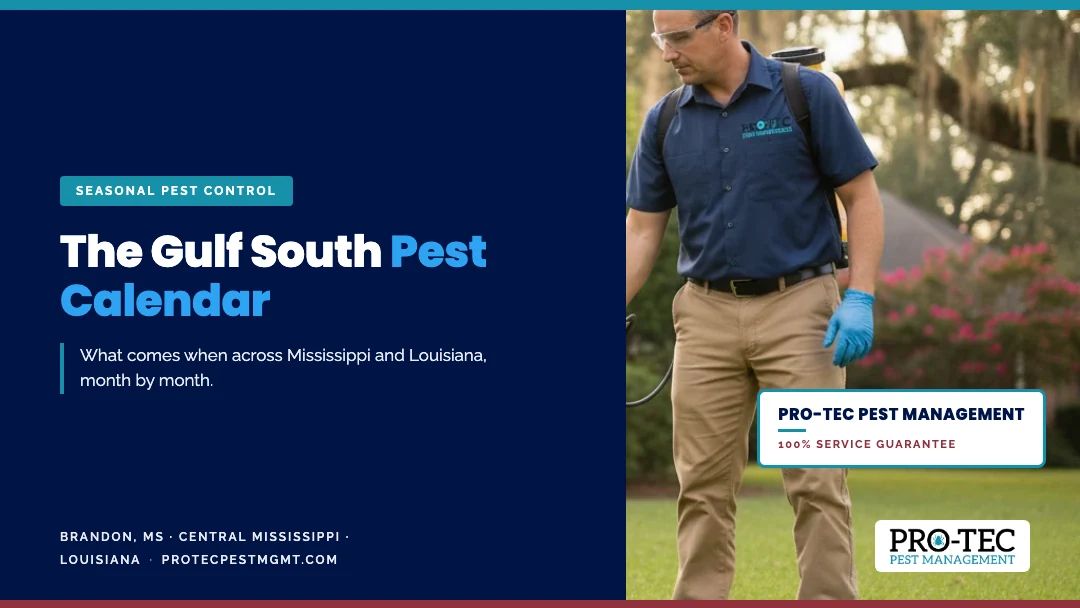
That does not mean every pest is active at once. The pressure changes shape through the year. Termites own the spring, mosquitoes own the summer, stinging insects flare in the fall, and rodents come knocking as the temperature finally drops. When you know what is coming, you treat ahead of it. Pro-Tec Pest Management built its year-round service around that calendar.
Want a plan matched to your address and the season we are in right now? Schedule a pest control assessment, or call Mississippi (601) 938-0079 / Louisiana (225) 369-2783.
The Gulf South Pest Season at a Glance
Before the month-by-month detail, here is the shape of the year. Each pest has a window when it is easiest to see and hardest to ignore, and the windows overlap more than most homeowners expect.
The takeaway is not any single bar. It is that some pest is always building somewhere on this chart, which is exactly why a reactive, call-when-you-see-one approach leaves gaps.
Spring: Termite Swarm Season
Spring is termite season in the Gulf South, and it arrives in two waves. The timing matters because a swarm is the one moment these hidden insects make themselves visible.
Native subterranean termites swarm first. Mississippi State University Extension notes in its guide to Mississippi termite species that native swarmers fly during the day in spring. They show up in coastal counties as early as late February and peak into early April, with northern counties running later, into April through June. The LSU AgCenter reports the same daytime pattern for native subterranean termites in its Louisiana termite swarm guidance.
The second wave is the one to respect. Formosan subterranean termites, an invasive species that builds far larger colonies, swarm at night from late April through June and peak around Mother’s Day, according to the same MSU and LSU sources. If you see a nighttime swarm around a porch light in May, that is your cue to act, not wait.
A swarm means a colony is already established nearby, so spring is when a termite plan earns its keep. Our guide on why Mississippi homeowners need a termite plan before March covers how a preventive plan gets you ahead of both swarms instead of reacting to visible damage. Termite work is specialized and regulated, so the inspection comes first.
Summer: Mosquito Season Peaks
By the time the termite swarms fade, mosquitoes are taking over the calendar. Warm, wet Gulf South summers are close to ideal for them.
The speed is the problem. Mississippi State University Extension’s southern house mosquito publication reports that a mosquito can go from egg to biting adult in just 8 to 10 days in warm weather. They breed in artificial containers, clogged drains, catch basins, and any low spot that holds water. A neglected birdbath or a stack of saucers under potted plants can seed a new generation in under two weeks.
Peak risk runs from midsummer into early fall. The same MSU publication notes that mosquito-borne encephalitis outbreaks usually occur from midsummer to early fall, which lines up with when the population is largest and most active. That is the stretch when yard treatment and source reduction matter most. Our Mississippi and Louisiana mosquito control guide walks through the targeted, reduced-risk approach that controls mosquitoes without soaking the yard your family and pets actually use.
Late Summer and Fall: Stinging Insects Turn Aggressive
Just as mosquito pressure starts to ease, stinging insects reach their most dangerous stretch. This is the season of the surprise nest in the eaves or the ground.
Yellowjacket and wasp colonies spend spring and summer growing, and by late summer they are at full size. The Alabama Cooperative Extension System, writing for the same Gulf South climate, states in its guidance on yellowjackets and outdoor stinging insects that the end of summer and fall are peak yellowjacket season, and that the insects grow more aggressive in fall as the colony begins to die out.
That combination, a large colony and a short temper, is why fall yard work and outdoor gatherings carry more sting risk than people expect. A nest that was invisible in June is a real hazard in September. Fall is the season to have the eaves, deck framing, and ground near the foundation checked before someone finds a nest the hard way.
Fall and Winter: Rodents Move Indoors
When the weather finally cools, the pest pressure moves from the yard to inside your walls. Rodents are the headline pest of the cold months.
As temperatures drop, mice and rats look for warmth, food, and shelter, and your home offers all three. The National Pest Management Association reports in its winter pest-proofing guidance that rodents invade an estimated 21 million homes across the country each winter. A mouse needs only a gap about a quarter inch wide to get in, which is why fall is exclusion season: sealing entry points before the first cold snap drives them looking for a door.
Mild Gulf South winters do not end the season, they just thin it out. The NPMA notes in its seasonal pest predictions that milder-than-normal temperatures extend pest activity into fall and even winter, since the first freeze that would normally slow things down comes late or barely at all. So-called occasional invaders such as stink bugs and ladybugs also push indoors in fall looking for a place to overwinter.
Why a Year-Round Plan Beats Chasing Each Season
Reading this calendar, the pattern is hard to miss: there is no dead month. Something is always building. That is the case for a proactive, year-round program instead of a series of emergency calls.
A reactive approach treats a pest only after it is visible, which by definition means the colony or population is already established. A year-round plan flips that. Each quarterly visit checks the home against the pest pressure that season brings and treats ahead of the wave, so the problem is smaller and cheaper to control. This is the same evidence-based logic behind our year-round 365 inspection program, which times inspection and treatment to the seasonal calendar rather than to whenever a homeowner happens to spot something.
| Season | Lead pest | The proactive move |
|---|---|---|
| Late winter to spring | Native and Formosan termites | Termite inspection and plan before the swarms |
| Late spring to summer | Mosquitoes | Source reduction and targeted yard treatment |
| Late summer to fall | Yellowjackets and wasps | Check eaves, decks, and ground nests early |
| Fall to winter | Rodents and occasional invaders | Seal entry points before the first cool snap |
It also fits how Pro-Tec approaches treatment overall. Our eco-friendly, inspection-first pest control approach means each seasonal treatment is targeted to the actual pressure, not a blanket spray on a fixed date. The calendar tells you what is coming. The plan makes sure you are ready for it.
Common Questions About Seasonal Pests in Mississippi and Louisiana
These are the timing questions Gulf South homeowners ask most through the year. The short version is that pest pressure here is nearly year-round and simply changes shape by season. The answers below cover the windows that matter.
When do termites swarm in Mississippi and Louisiana?
Native subterranean termites swarm during the day in spring, as early as late February in coastal areas and peaking into early April. Formosan termites, the more destructive invasive species, swarm at night from late April through June, peaking around Mother’s Day. A visible swarm means a colony is already nearby, so spring is the season for a termite inspection.
When is mosquito season worst in the Gulf South?
Mosquitoes build through the summer and peak from midsummer into early fall, which is also when disease risk is highest according to Mississippi State University Extension. Because a mosquito can go from egg to adult in 8 to 10 days in warm weather, removing standing water every week through the summer makes a real difference.
Do pests really stay active all winter in Mississippi?
Largely, yes. Mississippi averages 210 to 240 frost-free days a year, so the hard freeze that normally ends pest season up north rarely arrives. Activity thins out in winter rather than stopping, and rodents and occasional invaders actually increase indoors as they seek warmth.
When do rodents come into the house?
Rodents move indoors as temperatures drop in fall and winter, seeking warmth, food, and shelter. Nationwide they invade an estimated 21 million homes each winter. Fall is the best time to seal entry points, since a mouse can get through a gap only about a quarter inch wide.
Why are wasps more aggressive in the fall?
Yellowjacket and wasp colonies reach their largest size by late summer, and they turn more aggressive in fall as the colony starts to die out. That combination of a big colony and short temper makes late-season yard work and outdoor gatherings riskier, so fall is the time to check for and remove nests.
Is it worth paying for pest control year-round in the Gulf South?
For most Gulf South homes, yes, because there is no genuinely pest-free month here. A year-round plan treats each pest ahead of its season, which is cheaper and more effective than emergency treatment after an infestation is established. It also catches termite and rodent activity early, when the damage and cost are still small.
The best time to treat a pest is before its season starts.
Pro-Tec Pest Management protects Mississippi and Louisiana homes on the Gulf South’s real calendar: termites in spring, mosquitoes in summer, stinging insects in fall, and rodents as the weather cools. A year-round plan gets you ahead of each wave instead of reacting after the damage is done.