How Pro-Tec Protects Your Home and the Environment
Quick Answer: Eco-friendly pest control is not a weaker service. It is Integrated Pest Management, the approach the EPA describes as inspecting first, preventing infestations by removing food, water, and shelter, and using pesticides only as needed. Pro-Tec inspects your Mississippi or Louisiana home, seals the entry points pests use, and treats precisely where the pressure is instead of dousing the property. It protects kids, pets, and pollinators while working better over time.
TLDR:
- Eco-friendly pest control at Pro-Tec means Integrated Pest Management (IPM), not a softer or less effective service.
- The EPA defines IPM as a prevention-first, monitoring-based approach and calls broadcast spraying of non-specific pesticides a last resort.
- The process is inspection-first: identify the pest, find the entry points and moisture sources, then treat only where needed.
- Exclusion and prevention (sealing gaps, cutting off food and water) do most of the work, so less chemical is needed.
- Targeted baiting and spot treatment protect children, pets, and pollinators far better than blanket spraying.
- Stronger conventional treatments are still used when the situation calls for it, applied precisely and by choice, not by default.
- The EPA describes this reduced-risk approach as more sustainable and generally lower cost over time, because it fixes the underlying cause.
Can you keep a Gulf South home pest-free without soaking it in chemicals every month? Yes, and the homes that do it best are usually the ones that spray the least. Mississippi and Louisiana homeowners feel real friction here. You want the roaches, ants, and termites gone, but you also have kids on the floor, a dog in the yard, a vegetable bed out back, and pollinators you would rather not poison. High humidity, mild winters, and a nine-to-ten-month active pest season across Brandon, the Jackson Metro, Rankin County, and into Louisiana keep the pressure on year-round. Pro-Tec Pest Management built its service around that reality.
The old assumption was that stronger meant more spray. The evidence points the other way. A precise, prevention-led program controls pests more reliably and puts far less product into the spaces where your family actually lives. This is the difference between an eco-friendly professional and a spray-and-go vendor, and it is the standard Pro-Tec works to.
Want to see what a reduced-risk plan looks like at your address? Schedule a pest control assessment, or call Mississippi (601) 938-0079 / Louisiana (225) 369-2783.
What Eco-Friendly Pest Control Actually Means
Eco-friendly is a marketing word until it is tied to a method. The method is Integrated Pest Management, and it has a real definition, not a green sticker.
The EPA’s introduction to Integrated Pest Management describes it as an approach that focuses on pest prevention and uses pesticides only as needed. Prevention comes first by removing the conditions that attract pests, mainly food, water, and shelter. The EPA’s IPM principles, updated in 2025, go further and call broadcast spraying of non-specific pesticides a last resort, with less-risky controls chosen first.
The National Pest Management Association frames it the same way. Its explanation of Integrated Pest Management describes a common-sense process built on inspection, identification, and treatment, where sealing gaps, sanitation, and environmental changes do much of the work and product application is one tool among several. That is what Pro-Tec means when it says eco-friendly. Reduced risk by design, not by wishful thinking.
Why Reduced-Risk Is More Effective, Not a Compromise
The worry most homeowners voice is simple. If you spray less, do you get worse results? For a prevention-led program, the answer runs the opposite direction.
A spray-and-go treatment kills the adults it lands on and does nothing about why they were there. The population rebuilds from the same food source, the same moisture, and the same open gap in the foundation. IPM addresses the cause, so the problem stops coming back on the same schedule.
The EPA is direct about the tradeoff in its IPM overview, noting that costs are generally lower over time because the underlying cause of the pest pressure has been addressed. Research on IPM programs has repeatedly found that pesticide use can drop sharply while control holds or improves, which is why extension services and regulators treat it as the professional standard rather than the budget option. Fewer chemicals and better results are not in tension here. They come from the same discipline.
The Inspection-First Process
Every Pro-Tec service starts with looking, not spraying. You cannot treat precisely if you do not know what you are dealing with or where it is getting in.
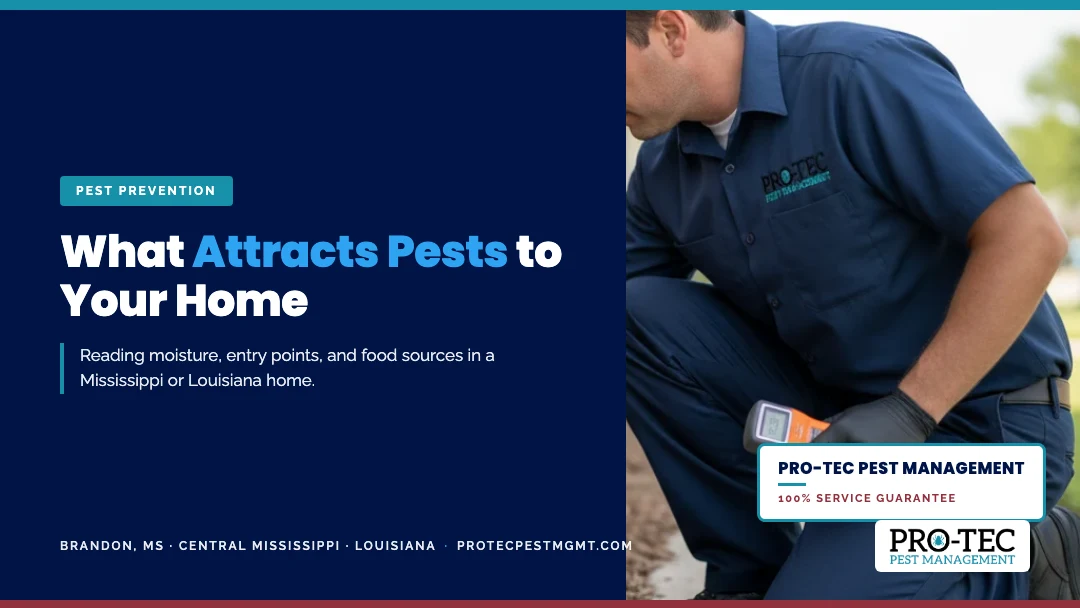
A technician walks the property and documents the specific pest, the entry points, the moisture sources, and the food and harborage that feed the infestation. That inspection produces a targeted plan instead of a generic application. Mississippi State University Extension makes the same point in its guidance on integrated pest control, describing insecticides as the treatment of last resort and the goal as keeping pests at acceptable levels while minimizing chemical use.
This is the same evidence-based method behind our year-round 365 inspection program, which checks a home against every seasonal pest pressure at each quarterly visit. Inspection is not the paperwork before the real work. It is the real work.

Prevention and Exclusion Do Most of the Work
The most eco-friendly treatment is the one you never have to apply, because the pest never got in. Prevention is where a reduced-risk program earns its results.
Exclusion means closing the doors pests use: sealing gaps around plumbing and utility penetrations, screening vents, caulking cracks, and cutting off the moisture and food that draw them. Mississippi State University Extension is blunt about how much this matters. In its publication on controlling household insect pests, it states that exclusion is the most important part of household insect control, and that if you keep pests out in the first place, you will not have a pest problem.
Louisiana guidance lands in the same place. The LSU AgCenter’s Louisiana perspective on integrated pest management notes that IPM does not exclude insecticides and is not based only on insecticides, and that prevention through moisture control and design is more cost-effective than remedial treatment. Seal the house, dry it out, deny the food, and you have already won most of the fight.
Targeted Low-Impact Treatment Over Broad Spraying
When treatment is warranted, precision is what keeps it eco-friendly. Where a product goes matters as much as which product it is.
Instead of a blanket perimeter fog, a reduced-risk program uses targeted methods matched to the pest: bait stations that carry a small, contained dose back to the colony, crack-and-crevice applications placed exactly where pests travel, and spot treatment confined to the pressure point. Baiting in particular concentrates the active ingredient where the pest is and keeps it away from the open surfaces where your family lives. Less product, placed better, does more work than more product spread everywhere.
This is also the honest version of the professional-versus-store comparison. Our guide on why professional pest control beats DIY methods covers why hardware-store foggers tend to scatter chemical broadly and miss the source, which is the opposite of the targeted approach a reduced-risk program is built on.
The two columns are not just greener versus less green. They are a program that treats the cause against one that treats the same symptom over and over.
Keeping Kids, Pets, and Pollinators Safe
For most Gulf South families, this is the real reason eco-friendly matters. The people and animals you are protecting share the same floors, yards, and gardens where pest control happens.
A targeted program lowers exposure by keeping product out of open living spaces and away from where children and pets spend time. That is the practical payoff of baiting and crack-and-crevice work over broadcast spraying. It puts the active ingredient in the pest’s path, not on the playroom floor or the dog’s water bowl.
Pollinators get the same consideration. The EPA’s actions to protect pollinators include limiting how and when certain pesticides can be applied when bees are present. A reduced-risk approach follows that spirit by treating precisely and by protecting the flowering plants and outdoor areas pollinators use, which matters for the same yards where you would rather control mosquitoes without harming bees. Our Mississippi and Louisiana mosquito control guide walks through the same targeted logic for outdoor pests.
When Stronger Treatment Is Still the Right Call
Eco-friendly does not mean anti-chemical. It means choosing the tool that fits, and sometimes the tool is a stronger conventional treatment applied with care.
A heavy infestation, a structural pest, or a wood-destroying organism can require a robust product to get control. Both the LSU AgCenter and the EPA are clear that IPM includes pesticides when they are the right answer. The difference is that in a reduced-risk program, the stronger treatment is a deliberate decision driven by the inspection, applied to the specific problem, not the default response to every call.
Termite work is the clearest example. It is a specialized, regulated service with its own inspection and treatment requirements. Our guide on why Mississippi homeowners need a termite plan covers where a targeted structural treatment is warranted and how it fits a prevention-first program. When the EPA runs a reduced-risk pesticide program that expedites products posing less risk to health and non-target organisms, it is reinforcing the same idea: use effective treatment, choose the lower-risk option first, and match it to the job.
Common Questions About Eco-Friendly Pest Control in Mississippi and Louisiana
These are the questions Mississippi and Louisiana homeowners ask most when they want strong results without heavy chemical use. The short version is that reduced-risk is a method, not a marketing claim. The answers below cover how it works in practice.
Is eco-friendly pest control as effective as conventional spraying?
Yes, and often more so over time. A prevention-led program addresses the food, water, and entry points that cause the problem, so pests do not rebuild from the same source. The EPA notes that Integrated Pest Management costs are generally lower over time because the underlying cause is addressed, not just the visible pests.
What is Integrated Pest Management (IPM)?
IPM is the professional framework behind eco-friendly pest control. The EPA defines it as inspecting and monitoring first, preventing infestations by removing food, water, and shelter, and using pesticides only as needed. Broad spraying of non-specific products is treated as a last resort, with lower-risk controls chosen first.
Is Pro-Tec’s approach safe for kids and pets?
A reduced-risk program is built to lower exposure for the people and animals in the home. Targeted baiting, crack-and-crevice work, and spot treatment keep product in the pest’s path and out of open living spaces where children and pets spend time, instead of coating floors and yards with broadcast spray.
Does eco-friendly pest control protect pollinators?
It is designed to. The EPA takes regulatory action to limit how and when certain pesticides are applied when bees are present. A targeted, prevention-first approach follows that logic by treating precisely and protecting the flowering plants and outdoor areas that pollinators use, rather than spraying broadly across the property.
Do you ever use stronger chemical treatments?
Yes, when the situation calls for it. A heavy infestation or a structural pest such as termites can require a robust conventional product. In a reduced-risk program, that decision comes from the inspection and is applied to the specific problem, choosing the lower-risk effective option first rather than defaulting to heavy spraying.
Why does prevention matter more than spraying?
Because the treatment you never have to apply is the safest and cheapest one. Mississippi State University Extension calls exclusion the most important part of household insect control, and LSU AgCenter notes that prevention through moisture control and design is more cost-effective than remedial treatment. Sealing entry points and cutting off food and water does most of the work.
How do I start an eco-friendly plan for my Gulf South home?
Start with an inspection. A technician identifies the pests, entry points, and moisture sources at your property, then builds a targeted plan around Pro-Tec’s year-round 365 protection model. You can request a free assessment online or call the Mississippi or Louisiana office to walk your property.
Effective pest control and a lighter chemical footprint are the same plan, not a tradeoff.
Pro-Tec Pest Management protects Mississippi and Louisiana homes with an inspection-first, reduced-risk approach: seal the entry points, cut off food and water, and treat precisely where the pressure is. Kids, pets, and pollinators stay protected, and the underlying cause gets addressed, not just the pests you can see.