Termite History Questions for Mississippi and Louisiana Home Buyers
Quick Answer: Before closing, ask the seller if the house was ever treated for termites, when, by whom, and with what. Ask if a termite contract is active, when it expires, and if it transfers to you. Then ask about past damage, who repaired it, and for the paperwork that backs up every answer.
TLDR:
- Louisiana’s seller disclosure form asks about past termites, damage, repairs, and any current termite contract.
- Mississippi’s disclosure form asks one termite question and never asks about a termite contract, so you have to ask.
- In Louisiana, state law says a currently effective termite contract transfers to a subsequent owner.
- In Mississippi, ask the pest company if you can assume the contract, and on what terms.
- Ask if the contract covers damage repairs or only retreatment. Mississippi requires that answer in bold on the contract.
- Bait systems stop protecting a house once the contract lapses. Liquid treatments usually keep working for years.
- A disclosure form is not a warranty in either state. An independent termite inspection is still your best check.
Termite history is easy to skip in a home purchase. The inspection report shows up clean, and nobody asks what came before. Pro-Tec Pest Management works on both sides of the state line, from Brandon and Meridian in Mississippi to Baton Rouge, Denham Springs, and Walker in Louisiana.
The seller, and the seller’s pest company, know things an inspector cannot see in one visit. This guide covers what to ask them, and names the state each time the rules differ.
Buying a home in Mississippi or Louisiana? Pro-Tec Pest Management inspects homes for termite activity, termite damage, and the conditions that draw termites in, so you know where the house stands before closing.
Start With What the Seller Already Disclosed
Both states require most sellers of a home to fill out a disclosure form. Read the termite answers first. They tell you which follow-up questions matter most.
In Louisiana, the Louisiana Real Estate Commission’s 2026 Property Disclosure Document has a full section on termites and wood-destroying insects. It asks if the property ever had termites, both during and before the seller’s ownership. It asks if there was damage and if that damage was repaired.
The same section asks for the name of the company, the expiration date, and any structures not covered when the home is under a termite contract. Under Louisiana Revised Statute 9:3198, the seller must deliver the form no later than the time you make an offer. If it arrives after your offer, you get 72 hours, excluding weekends and holidays, to back out without penalty.
In Mississippi, the Mississippi Real Estate Commission’s Property Condition Disclosure Statement is required under Mississippi Code sections 89-1-501 through 89-1-527. Its termite question asks if the seller is aware of “the presence of, or damage (repaired or unrepaired) caused by, termites or wood-destroying insects.” That is the only termite question on the form.
Both forms rest on what the seller actually knows. Louisiana’s statute says the disclosure “shall not be considered as a warranty by the seller,” and Mississippi’s form says the same. A seller can mark “no knowledge” in Louisiana or “unknown” in Mississippi, which is why the follow-up questions below matter.
Question 1: Has the House Been Treated, When, and With What?
Treatment history tells you how protected the house is today.
Mississippi State University Extension’s guide, Protect Your House from Termites, tells buyers to talk with the previous owner about the building’s history. Its suggested questions: when was it built, when was it last treated and with what termiticide, has it ever been infested, and is it under a termite contract now?
The “with what” part matters. The EPA’s termite control guidance names the two common forms of treatment: conventional barrier treatments and termite baits. They behave very differently once a contract ends.
- Liquid soil treatment: The MSU guide says a properly applied liquid termiticide usually keeps working for years, even if the contract is not renewed.
- Bait system: The same guide says that when a bait contract lapses, the stations are removed and the building is left without termite protection.
So “yes, it was treated” is only half an answer. Ask for the treatment type, the date, and the company name, then move on to the contract.
Question 2: Is There an Active Termite Contract, and Will It Transfer?
Many people call it a “termite bond.” Either way, you want to know if it is in force and if it will cover you after closing.
In Louisiana, Louisiana Revised Statute 3:3370 says any currently effective standard contract, with all its terms and conditions, “shall be transferable to a subsequent owner of the property covered by such contract.” The same statute requires the company to give the property owner, or the owner’s agent, a copy of the current contract within 30 days of a written request.
You are not the owner yet, so ask the seller to request that copy early.
In Mississippi, Rule 115 of the Bureau of Plant Industry’s professional services regulations requires a termite contract to guarantee the work to the original owner and subsequent owners for at least one year after the initial contract date. The rule does not spell out transfers after that first year, so check the contract itself. The MSU guide suggests checking with the pest company to see if they will let you assume the contract by paying the next annual renewal fee.
Questions to put to the seller and the seller’s pest company:
- What is the company’s name, and when does the contract expire?
- Which structures does it cover? Louisiana’s form asks the seller to list any that are not covered.
- What steps does the company require before the contract moves to a new owner, and is there a fee or deadline?
- Will the company inspect the house before or after the transfer?
Get the answers in writing from the company, not secondhand. Then read what the contract actually promises.
Not sure what the seller’s termite contract really covers? Our team can inspect the home and walk you through what we find. Then you can ask the right questions before closing.
Question 3: Does the Contract Cover Repairs, or Only Retreatment?
This question decides what happens if termites come back. Many buyers assume a termite contract pays for damage. Often it does not.
The MSU guide says most contracts today only provide for retreating the structure if it becomes reinfested, while some companies still offer damage repair contracts as an extra option. In Mississippi, Rule 115 requires the contract to “clearly state in bold letters on the face of the contract if damage repairs are included or if only retreatment is provided.” Look for that line.
In Louisiana, R.S. 3:3370 requires a standard contract to guarantee retreatment if the property becomes reinfested within one year of treatment. For new construction, the June 2025 edition of Louisiana’s structural pest control rules requires the contract to include a damage repair warranty of at least $25,000, subject to the contract’s terms. For an older home, read the contract itself to see what it covers.
Two more things to ask for while you have the contract in hand:
- Inspection reports. Mississippi’s Rule 115 requires a yearly re-examination of the treated property, with a written report filed with the owner. Louisiana’s rule 119 requires at least one inspection of the accessible areas outside the structure before the agreement expires.
- The diagram. Both states require a diagram of the treated structure. Mississippi requires a work order with a plot or diagram for the property owner, and Louisiana requires inspection diagrams showing every structure covered.
Years of clean inspection reports tell a better story than a file with gaps. Next, ask about damage.
Question 4: Was There Damage, Who Repaired It, and Was It Checked Afterward?
Past damage alone does not rule out a house. Unanswered questions about that damage should slow you down.
Louisiana’s form asks two direct questions: was there any damage, and was it repaired? Mississippi’s form folds damage into its single termite question, “repaired or unrepaired.” A “yes” on either form opens the door to specific follow-ups:
- Where was the damage, and how was it found?
- Who did the repairs, and are there invoices or photos?
- Was the house treated before the repairs were made?
- Did a pest company inspect the area after the repairs?
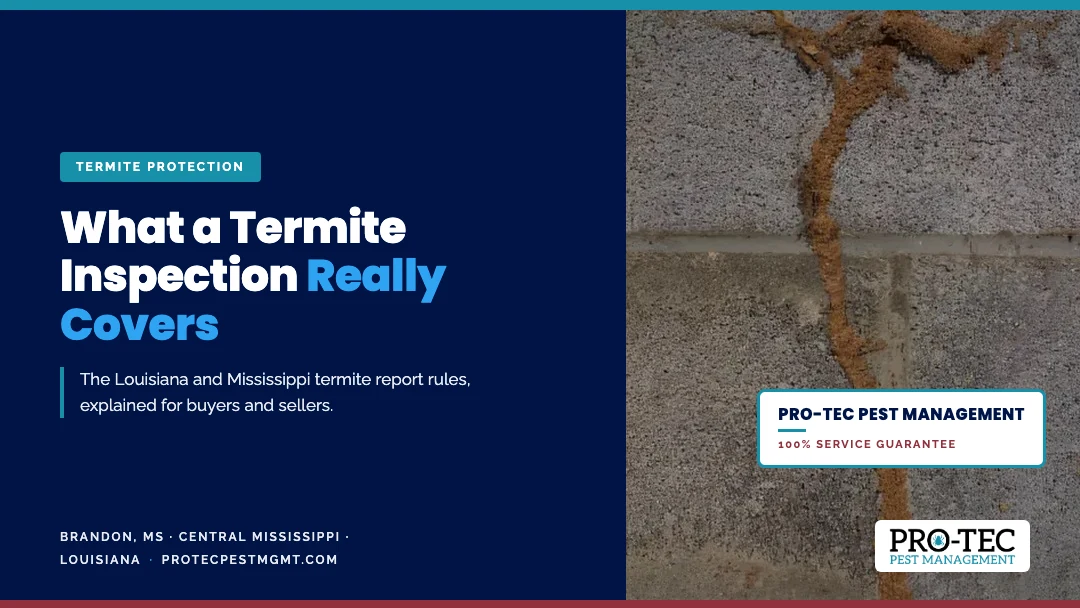
The MSU guide notes that dried mud in termite galleries with no live termites could be old damage from an infestation that was controlled in the past. Only a professional inspection can tell you which one you are looking at.
Paperwork is the thread that ties all five together. In Mississippi, Rule 111.01 requires termite companies to keep treatment records, inspection reports, and contracts for as long as a contract is current and for two years after it expires. Ask the seller’s pest company for copies.
Red Flags in the Seller’s Answers
Some answers should send you to a professional before closing.
- “Unknown” on every termite question, with no paperwork. The MSU guide advises retreating a home when the previous owner does not know when it was last treated.
- A bait system with a lapsed contract. Per the MSU guide, protection stops when the stations are removed.
- Damage marked “yes” with no repair records. You cannot tell if the colony was treated before the wood was patched.
- Structures left off the contract, such as a detached garage or shed on a Louisiana form.
- A contract that expires right before closing, with no word from the company on renewal or transfer.
None of these means the house is a bad buy. Each means the history is incomplete, and an independent inspection fills the gap.
What to Do Before Closing Day
The seller’s answers tell you the history. An inspection tells you the present.
Start with a licensed termite inspection of the home, separate from the seller’s contract company if you prefer a fresh set of eyes. Our guide on what a real termite inspection covers in Mississippi and Louisiana explains the official state report, its limits, and how to read it.
If the house has no active contract, or the contract will not transfer, plan for protection after you move in. Pro-Tec’s termite control and inspection service covers homes across both states, including termite treatment for Baton Rouge buyers and termite protection around Brandon, MS.
Common Questions About a Home’s Termite History in MS and LA
These are the termite history questions buyers ask most when a Mississippi or Louisiana closing is on the calendar. Each answer names the state it applies to.
Does a Louisiana seller have to disclose termite damage?
Yes, to the extent the seller knows about it. Louisiana’s Property Disclosure Document asks if the property ever had termites or other wood-destroying insects, if there was damage, and if it was repaired. The seller answers in good faith and may mark no knowledge. The form is not a warranty.
Does Mississippi’s disclosure form ask about termites?
Yes, in one question. The Property Condition Disclosure Statement asks if the seller is aware of the presence of, or damage caused by, termites or wood-destroying insects, repaired or unrepaired. It does not ask about a termite contract or past treatments, so buyers need to ask the seller directly.
Does a termite contract transfer when you buy a house?
In Louisiana, state law says any currently effective standard termite contract transfers to a subsequent owner of the covered property. In Mississippi, the contract must cover subsequent owners for at least its first year. After that, check the contract’s terms and ask the pest company how a transfer works.
What is the difference between a retreat contract and a repair contract?
A retreat contract covers treating the house again if termites return while it is in force. A repair contract also covers fixing termite damage, under its terms. Mississippi requires the contract to state in bold which type it is. Read the contract before assuming repairs are covered.
What if the seller does not know the termite history?
Treat the unknown as a reason to inspect. Get a licensed termite inspection before closing. MSU Extension advises having a home retreated when the previous owner does not know when it was last treated. A pest company can recommend next steps after seeing the house.
Is a bait system still protecting the house if the contract lapsed?
Probably not. MSU Extension notes that when a bait contract lapses, the stations are removed and the building is left without termite protection. Liquid soil treatments usually keep working for years without a contract. Ask the seller which type the house has and when service stopped.
Know the termite history before the house is yours.
Pro-Tec Pest Management inspects and protects homes across Mississippi and Louisiana. Tell us where you are in the buying process, and we will lay out clear findings and next steps before you close.