What Mississippi and Louisiana Homeowners Should Know About Pest Inspections
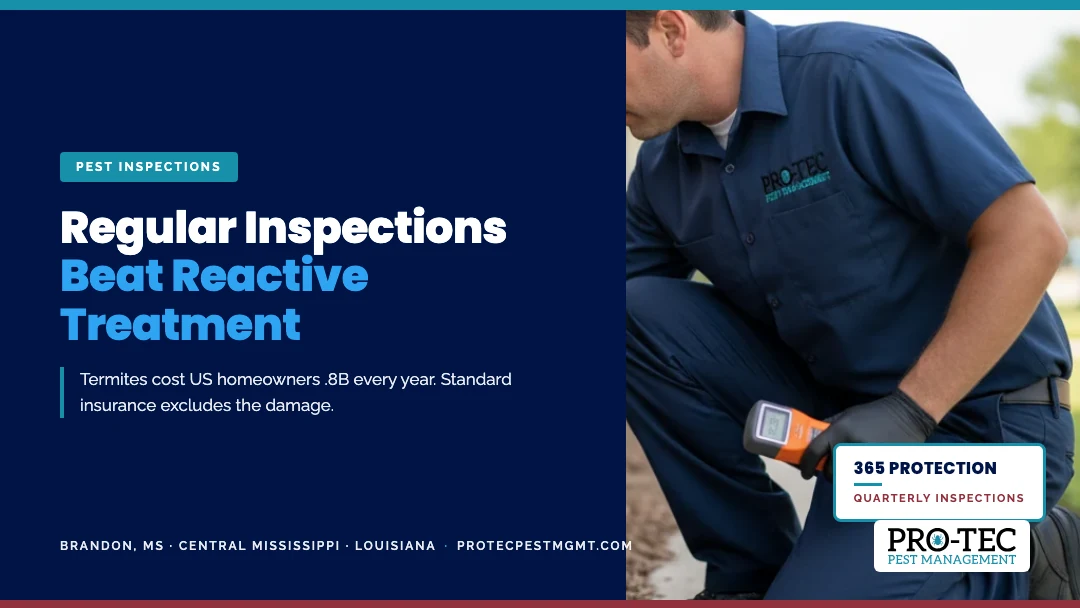
Quick Answer: Termites alone cost US homeowners $6.8 billion in property damage every year, and standard homeowners insurance excludes nearly all pest-related damage. Homes on recurring inspection and treatment plans report 90 percent fewer emergency pest sightings than homes relying on reactive one-time treatments. Regular pest inspection costs less per year than a single major repair caused by what an inspection would catch.
TLDR:
- US homeowners lose $6.8 billion to termite damage every year, and standard homeowners insurance excludes nearly all pest-related damage as a maintenance issue.
- Termites alone damage roughly 600,000 US homes annually, with average repair costs between $550 and $3,000 per home.
- Homes on recurring pest service plans report 90 percent fewer emergency pest sightings than homes that rely on reactive one-time treatments.
- A quarterly recurring plan averages $400 to $600 per year, often less than two one-time treatments plus follow-up callbacks.
- Only 31 percent of US homeowners take preventive pest measures and 27 percent have ever had a professional termite inspection, per NPMA.
- Pro-Tec’s 365 protection model combines quarterly visits, standing-water audits, entry-point inspections, and treatment for the specific pests pressuring your Mississippi or Louisiana property.
What does it actually take to keep a Mississippi or Louisiana home pest-free over the long run? Most homeowners answer that question with reactive treatment: see a pest, call someone, treat the problem, move on. The numbers don’t support that approach. Mississippi homeowners face termite swarming season from February through May plus year-round subterranean termite pressure thanks to the state’s mild winters and high soil-moisture conditions. Louisiana humidity drives roach, rodent, and termite activity essentially year-round. Pro-Tec Pest Management’s regional service across Brandon, Mississippi through Central Mississippi and into Louisiana means our inspection program is built around the actual Gulf South pest calendar, not a generic national playbook.
We’ve serviced Mississippi homes long enough to see the pattern in our own customer base. The customers who call us in a panic after spotting termite damage almost always spent more money over the previous three years on reactive treatments than a 365 plan would have cost. Here’s what every Mississippi or Louisiana homeowner should understand about the economic case for regular professional inspection. The numbers aren’t subtle.
Skip the reactive cycle and request a property assessment, or call Mississippi (601) 938-0079 / Louisiana (225) 369-2783.
The Real Cost of Pest Damage in the United States
Termites alone cause $6.8 billion in property damage every year in the United States, damaging roughly 600,000 homes annually, per the National Pest Management Association. The average homeowner who finds termite damage spends $2,600 on repairs, with most cases running between $550 and $3,000 and severe cases reaching $10,000 or more, per 2025 cost-guide data.
US residents spend an estimated $5 billion annually on termite control and repair combined. NPMA’s 2024 survey found that 54 percent of US homeowners are aware of the damage termites can cause. Only 31 percent take preventive measures, and only 27 percent have ever had a professional termite inspection.
Why do these numbers matter to a Mississippi homeowner specifically? Two reasons. First, subterranean termites are the dominant species across the Gulf South, which puts MS and LA squarely in the high-pressure zone for the most expensive pest category. Second, the state’s tenth-place ranking among US states for West Nile cases (1999 through 2024) tells the same story on the disease-cost side. Property damage and disease exposure are both elevated here compared to most of the country. Reactive-only treatment leaves both costs on the homeowner.
Why Homeowners Insurance Won’t Cover Pest Damage
Standard HO-3 homeowners insurance policies in the United States explicitly exclude damage caused by birds, vermin, rodents, and insects. Insurers consider pest damage a homeowner maintenance responsibility, not a sudden or accidental peril, per Insurify’s homeowners insurance reference.
This means termite damage, rodent damage, ant damage, cockroach contamination, and mosquito-borne illness all sit outside the standard policy. The maintenance exclusion is industry-standard across nearly every major US insurer.
Most pest-control content treats this as a footnote. We treat it as the entire economic case. There’s no insurance product available that meaningfully covers pest damage on a residential property. None. The only proactive risk reduction is a recurring professional inspection and treatment program. Documentation of regular inspection becomes useful in property-sale negotiations and in any future insurance claim where pest involvement might otherwise complicate coverage.
There are narrow exceptions. If a rodent chews through wiring in an attic and the chewed wire starts a fire, the fire damage is typically covered (fire is a named peril). But the rodent damage itself is still excluded, per Bankrate’s homeowners insurance analysis. Similarly, if a burst plumbing pipe causes water damage that subsequently attracts termites, the original water-damage incident may be covered. These exceptions are narrow. Most homeowners never qualify.
So what’s the practical move? Treat pest inspection like the maintenance line item it is. Roof maintenance, HVAC tune-ups, gutter cleaning, pest inspection. Insurance won’t pay for the failure mode on any of them. Each one’s the homeowner’s bill if neglected.
How Regular Pest Inspections Actually Work
A professional pest inspection covers the entire exterior and interior of a property in roughly 45 to 90 minutes, depending on home size. The inspector documents entry points, moisture sources, signs of past activity, current pest pressure, and recommended treatment or exclusion work.
A typical inspection checklist includes the foundation perimeter (where entry-point sealing assessment happens), the crawlspace or basement (moisture and wood-destroying-organism check), the attic (rodent and insect activity signs), plumbing penetrations and utility entries, standing-water sources, wood contact with soil (termite risk), and stored-food protection areas.
The inspection produces an evidence-based treatment recommendation. Treatment targets the specific pest pressure documented during inspection, not a generic catch-all spray. That’s the difference between an inspection-led service and a spray-and-go vendor. The inspection-led approach treats what’s actually present.

Recurring Plans vs Reactive Treatment: The Real Math
A quarterly recurring pest plan averages $400 to $600 per year in the United States, per 2026 industry pricing data. One-time emergency treatments cost $171 to $280 initially, per HouseCall Pro’s 2026 pricing reference, but typically require 2 to 4 callback visits to resolve a single infestation. The effective annual cost of reactive-only service runs $400 to $650, before any property damage.
Effectiveness data tilts the comparison further. Per National Pest Management Association data via Catseye Pest, preventive treatment plans are 65 to 80 percent more effective than reactive treatment at maintaining a pest-controlled environment. Homes on recurring plans report 90 percent fewer emergency pest sightings.
The dollar figures look similar at first glance. The outcomes are dramatically different. Reactive-treatment homes spend roughly the same dollar amount but live with ongoing pest pressure between callbacks. Recurring-plan homes spend the same dollars on a planned schedule and report 90 percent fewer emergency sightings while doing it. Comparable cost. Very different experience. Very different property-damage exposure.
Why Mississippi and Louisiana Homes Need Year-Round Coverage
Mississippi and Louisiana sit in a year-round pest pressure zone. Average annual humidity above 70 percent, mild winters, and a 9-to-10-month active season for most pest species mean reactive-only homeowners are perpetually behind the curve. The local pest calendar shapes Pro-Tec’s quarterly visit timing.
Late February through May. Termite swarming season. Subterranean termites and the more aggressive Formosan termites (a Louisiana concern in particular) emerge in heavy numbers.
May through September. Mosquito and outdoor pest peak. Our companion Mississippi & Louisiana Mosquito Control guide covers the breeding-source-elimination work and recurring perimeter coverage that sits inside the 365 plan.
August through October. Late-summer roach indoor migration. Heat drives them inside; the kitchen-pest pressure climbs.
October through November. Pre-winter rodent push. Cold drives mice and rats into wall voids and attics, often through gaps as small as a quarter inch.
November through December. Holiday cooking activity and stored food create kitchen pest pressure, and warm attics attract overwintering rodents and squirrels.
A property on a reactive-only schedule typically sees one pest type at a time, treats that pest, and moves on. A property on a 365 plan gets inspected against ALL of these pressures at each visit, with treatment matched to the season.
What Pro-Tec’s 365 Protection Includes
Pro-Tec’s 365 protection plan covers four quarterly visits per year. Each visit combines a full property inspection, standing-water audit, entry-point assessment, and targeted treatment for the specific pests active in the current season.
Each quarterly visit produces a documented service record. That documentation matters when selling the home, when a future insurance claim involves a covered peril (the rodent-fire example above), and for the homeowner’s own peace of mind about what’s actually being treated. Free re-treatments between visits are covered for active customers if pest activity emerges between quarterly stops, backed by our 100 percent service guarantee.
Termite protection is a separate service with its own warranty and inspection requirements (governed by state regulations in both Mississippi and Louisiana). The 365 plan covers cockroaches, ants, spiders, rodents, mosquitoes, occasional invaders, and stored-product pests common to Gulf South homes.

To talk through what 365 coverage would look like at your address, request a property assessment or call Mississippi (601) 938-0079 or Louisiana (225) 369-2783.
Common Questions About Pest Inspections in Mississippi and Louisiana
These are the questions Mississippi and Louisiana homeowners ask most often when considering whether to switch from reactive treatment to a recurring inspection plan. The numbers above explain the why. The answers below cover the practical details.
How often should I have my home inspected for pests in Mississippi or Louisiana?
Most Gulf South homes benefit from quarterly inspections through a recurring 365 protection plan. Spot inspections before a home purchase, after major weather events, or during a suspected infestation supplement the quarterly schedule. Annual termite-specific inspections are a separate service due to regulatory and warranty requirements.
Does homeowners insurance cover termite or rodent damage?
Standard HO-3 homeowners insurance policies exclude pest damage under the maintenance-responsibility clause. Termite damage, rodent damage, and mosquito-borne disease are all considered preventable and therefore the homeowner’s responsibility. Pest insurance is effectively only available through a recurring inspection and treatment plan.
Is preventive pest control actually worth the cost?
National Pest Management Association data shows recurring plans are 65 to 80 percent more effective than reactive treatment and produce 90 percent fewer emergency pest sightings. Annual cost is comparable to two one-time emergency treatments, before any property damage. Most Gulf South homeowners save money on a recurring plan.
What does a professional pest inspection actually cover?
A typical inspection covers the property foundation perimeter, crawlspace or basement, attic, plumbing penetrations, utility entries, wood-soil contact points, standing-water sources, stored-food protection, and visible signs of past or current pest activity. Findings are documented and inform a targeted treatment recommendation.
How long does a professional pest inspection take?
Most residential pest inspections run 45 to 90 minutes depending on home size, presence of a crawlspace or basement, and current pest pressure. The inspector documents findings on-site and discusses them with the homeowner before leaving. A written follow-up report is delivered within a few business days.
Can I just spot-treat when I see pests instead of paying for recurring service?
Spot-treatment kills visible adults but doesn’t address the source. Most pest populations rebound within 7 to 30 days depending on species and conditions. Homeowners on reactive-only treatment typically pay 2 to 4 callback visits per infestation, often costing more than a quarterly recurring plan would have.
How does Pro-Tec’s 365 plan compare to other recurring services?
Pro-Tec’s 365 plan combines quarterly visits with standing-water audits, entry-point inspections, targeted treatment for the specific pests active each season, free re-treatments between visits, and documented service records. The 100 percent service guarantee backs every visit. Pricing and specifics vary by property size; we provide a free assessment before quoting.
Stop paying twice for the same pest problem.
Pro-Tec Pest Management’s 365 protection plan covers Mississippi and Louisiana homes with four quarterly visits per year, standing-water audits, entry-point inspections, and treatment for the specific pests active in the current season. Documented inspection records back every visit.
Call Mississippi (601) 938-0079 or Louisiana (225) 369-2783 to talk through your property, or request a free assessment online.