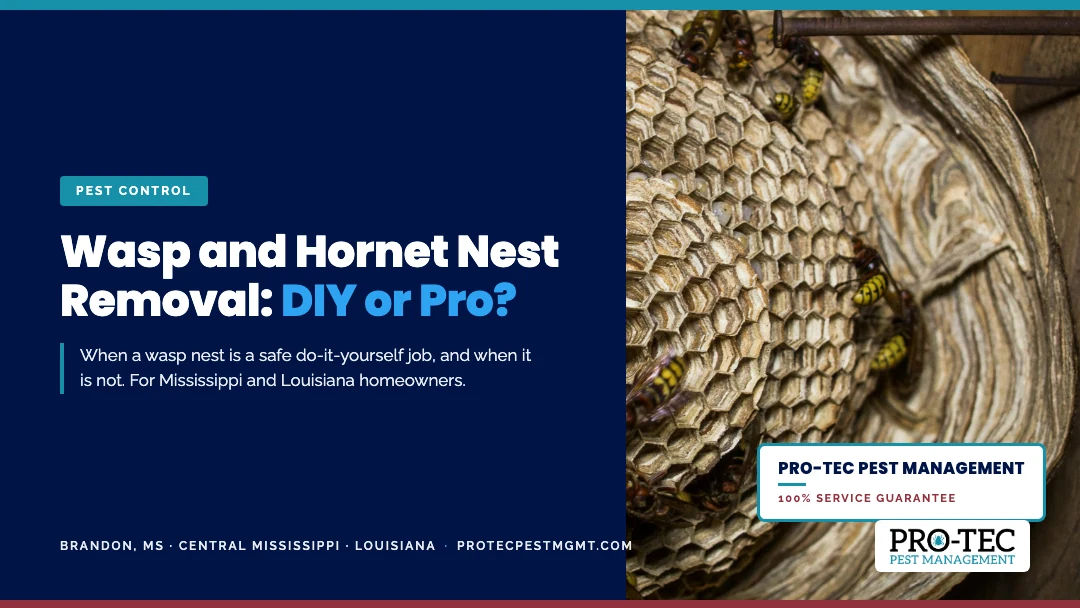
Should You Remove a Wasp or Hornet Nest Yourself?
Quick Answer: A small, newly built paper wasp nest in an open, reachable spot is a reasonable do-it-yourself job with an aerosol wasp spray, done at night. Call a professional for yellowjacket nests in the ground, any nest inside a wall or structure, bald-faced hornet nests, aggressive species, nests you would need a ladder to reach, or any situation where someone in the home has a sting allergy. The difference is mostly about the species, the nest location, and who is at risk.
TLDR:
- A small, early-season paper wasp nest in the open is the main case where careful DIY makes sense, using an aerosol spray after dark.
- Yellowjackets nest in the ground, sting repeatedly, and turn aggressive in late summer. Large or in-ground nests are a professional job.
- Bald-faced hornets build the big gray football nests and fiercely defend them. Leave those to a pro.
- Most insects people in Mississippi and Louisiana call “hornets” are actually paper wasps, yellowjackets, or harmless cicada killers.
- Insect stings cause an average of 72 deaths a year in the US, and about 3 percent of adults are at risk of a severe reaction, so allergy in the household changes everything.
- Never burn or flood a nest with gasoline. It is dangerous, ineffective, and in some places illegal.
- Nests are smallest and safest to address in spring and early summer, and most dangerous in late summer and fall.
Stinging insects are part of summer in the Gulf South. By the time most Mississippi and Louisiana homeowners notice a nest, it is tucked under an eave, humming in a flowerbed, or hanging from a tree, and the real question is not how to kill it but who should be the one doing it. Some of these jobs are genuinely fine to handle yourself. Others send people to the emergency room.
This guide walks through how to tell which is which: what you are actually dealing with, when do-it-yourself is reasonable, when it is not, and the sting facts that should drive the decision. For the bigger picture on staying ahead of seasonal pests, see our guide on why regular pest inspections matter more than reactive treatment.
First, What You Are Actually Dealing With
The word “hornet” gets used loosely here. Mississippi State University Extension’s overview of regional stinging insects notes that the only true hornet commonly found in the state is the introduced European hornet, and LSU AgCenter points out that the bald-faced hornet is not a hornet at all but a close relative of the yellowjacket. Many “hornets” people report are actually large paper wasps or harmless cicada killers. Getting the identification right is the first safety step, because the species tells you how the nest will behave.
The table below covers the stinging insects Mississippi and Louisiana homeowners encounter most.
| Insect | What it looks like and where it nests | How it behaves |
|---|---|---|
| Paper wasps | Slender, with long legs that dangle in flight. Open, umbrella-shaped comb under eaves and in sheltered spots. | Generally sting only when the nest is seriously threatened. |
| Carolina paper wasp | Large and orange with black wings. Nests in dark, enclosed voids like eaves, sheds, and pipes. | Notably defensive. Guards will fly out at someone within about ten feet. |
| Yellowjackets | Black and yellow. Tiered paper nest hidden in a cavity, usually underground, sometimes in walls or attics. | Very defensive. Sting repeatedly, and most stings come from disturbing a hidden nest. |
| Bald-faced hornet | Black with a white face. Large gray football-shaped nest hanging in shrubs or trees. | Fiercely defends the nest, stings repeatedly, and recruits more defenders with alarm scent. |
| European hornet | Large, brown and yellow. Nests in hollow trees and wall voids, more common in north Mississippi. | Painful sting, and unusual among wasps for flying at night and coming to lights. |
| Cicada killer | Very large, up to an inch and a half, with a yellow-banded body. Digs tunnels in bare, sandy soil. | Intimidating but not aggressive. Solitary, and best left alone. |
| Mud daubers | Long, narrow waist. Tube or pipe-shaped mud nests on walls, eaves, and sheds. | Not aggressive and do not defend the nest. Stings are rare. |
A quick read on that table: the bottom two rows, cicada killers and mud daubers, look alarming but rarely need treatment at all. The danger sits with yellowjackets and bald-faced hornets, and with the Carolina paper wasp when it nests somewhere enclosed.
When Do-It-Yourself Is Reasonable
There is one situation where careful DIY clearly makes sense: a small, recently built paper wasp nest in an open, reachable location. Mississippi State Extension’s guidance on paper wasps notes these are easily eliminated with an aerosol wasp and hornet spray when the proper precautions are taken.
If that describes your situation, the extension consensus on safe technique is consistent. Treat the nest at night or in the very early morning, when the wasps are inside and least active. Use a wasp and hornet aerosol that sprays from a distance so you are not standing under the nest. Wear long sleeves and pants, plan an exit path before you spray, and do not use a ladder to reach a nest, since a sting while you are up high is its own emergency.
After treatment, leave the nest alone for at least a day before removing it. Even a well-treated nest can keep releasing newly emerged insects for several days, so a second application is sometimes needed before the nest is truly dead.
When to Call a Professional
Most of the nests that worry people fall outside the safe-DIY zone, and the honest answer is to hand them off. Alabama Extension’s guidance on yellowjackets is blunt about large colonies: call a licensed pest control company, because over-the-counter aerosols have limited effect on a full nest. The eXtension network’s stinging-insect removal guidance adds that hiring a professional is the safest route when a nest is inside or within the walls of a structure.
Use the table below as a simple decision guide.
| The situation | The call |
|---|---|
| Small, new paper wasp nest, open and within easy reach | Reasonable to DIY at night, with precautions |
| Yellowjacket nest in the ground, especially a large or late-season one | Call a professional |
| Any nest inside a wall, attic, or structural void | Call a professional |
| Bald-faced hornet football nest in a tree or shrub | Call a professional |
| Carolina paper wasp or other aggressive species in an enclosed spot | Call a professional |
| Nest you would need a ladder to reach | Call a professional |
| Anyone in the household has a known sting allergy | Call a professional |
That last row carries more weight than the others, and the next section explains why.
The Sting Danger Most People Underestimate
Wasps, yellowjackets, and hornets are not like honeybees. The American College of Allergy, Asthma and Immunology explains in its overview of insect sting allergies that these insects can sting repeatedly, while a honeybee leaves its barbed stinger behind and stings only once. A disturbed yellowjacket or hornet nest can deliver dozens of stings in seconds.
The ACAAI also reports that insect stings cause an average of 72 deaths a year in the United States, and that roughly 3 percent of adults are at risk of a life-threatening allergic reaction. For someone in that group, a nest is not a nuisance. It is a medical risk, which is why any sting allergy in the household should move the job straight to a professional.
Know the emergency signs. Call 911 if a sting is followed by trouble breathing, tightness in the chest, swelling of the lips, tongue, face, or throat, dizziness, or a feeling that something is very wrong. Mayo Clinic’s first-aid guidance for stings warns not to wait to see if symptoms improve, and to use an epinephrine auto-injector immediately if one is available. Untreated, a severe reaction can be fatal within minutes.
Even without an allergy, a swarm of defensive stings from a large colony is dangerous on its own. That risk is not constant through the year, which brings up timing.
Timing Matters: The Gulf South Wasp Calendar
A wasp colony in July is not the same threat as the same colony in September. Yellowjacket and hornet nests are founded by a single overwintered queen in spring, stay small through early summer, then grow all season. LSU AgCenter’s work on yellowjackets describes colonies reaching hundreds or even thousands of workers by late summer, exactly when food sources dwindle and the insects turn more aggressive and start moving toward homes.
The practical takeaway is to deal with nests early when you can, and to be especially careful around the ground in late summer. Alabama Extension warns that mowing near a hidden yellowjacket nest in late season is a common way people get swarmed, since the vibration alone can trigger a defensive response.
What Not to Do
A few popular methods are worse than the problem. The most important: never pour gasoline into a nest or set it on fire. The eXtension stinging-insect guidance is clear that burning or flooding a nest is dangerous, often ineffective, damages your property, and is illegal in some areas. Every season there is a viral video of someone doing exactly this and getting hurt.
Two more to skip. Do not rush back to dig up or poke a nest you just treated, because surviving insects keep emerging for days. And do not swat at or grab cicada killers and mud daubers. They are not aggressive, but anything will sting if you trap it against your skin.
When in doubt, the safe move is to keep your distance and make a call. A professional treatment removes the guesswork, the ladder, and the risk all at once.
Common Questions About Wasp and Hornet Nests in Mississippi and Louisiana
These are the questions homeowners ask us most once a nest shows up.
How do I know if a nest is safe to remove myself?
It comes down to species, size, and location. A small, new paper wasp nest in an open, reachable spot is reasonable to treat yourself at night with an aerosol spray. A yellowjacket ground nest, a bald-faced hornet nest, anything inside a wall, or anything that needs a ladder is a professional job. If anyone in the home has a sting allergy, call a pro regardless.
Are bald-faced hornets and yellowjackets really that aggressive?
Yes. Both defend their nests fiercely, sting repeatedly, and can recruit more of the colony to join the attack. A disturbed nest can deliver many stings in seconds. These are the species most likely to send someone to urgent care, and they are best handled by a professional.
When is the worst time of year for wasps in the Gulf South?
Late summer and early fall. Colonies reach their largest size of the year, food gets scarce, and the insects become more aggressive and more likely to move toward homes. Nests are smallest and easiest to deal with in spring and early summer.
Is it safe to burn or flood a wasp nest?
No. Pouring gasoline into a nest or setting it on fire is dangerous, frequently ineffective, damages your yard and home, and is illegal in some areas. It also tends to provoke the colony before it kills it. Use a proper treatment or call a professional instead.
What should I do if I get stung and feel sick?
Treat it as an emergency. Call 911 if you have trouble breathing, chest tightness, swelling of the lips, tongue, face, or throat, dizziness, or a sense that something is seriously wrong. Use an epinephrine auto-injector right away if you have one. Do not wait to see if symptoms pass on their own.
Will the nest come back after it is removed?
The specific nest will not be reused, since these colonies last only one season and die out by winter. But the same conditions that drew wasps to your property can attract new nests the following year. Sealing entry points and a recurring inspection schedule are how you keep the problem from repeating.
Not sure what is nesting on your property, or if it is safe to handle?
Pro-Tec Pest Management removes wasp, hornet, and yellowjacket nests safely across Mississippi and Louisiana, including the in-ground and in-wall nests that are too risky to tackle yourself. We identify the species, treat the nest, and help you seal up the spots that invite them back.
Call Pro-Tec at (601) 938-0079 in Mississippi or (225) 369-2783 in Louisiana, or request a free assessment online.