
How to Read Termite Warning Signs in Mississippi and Louisiana
Quick Answer: Four signals point to termites: earthen mud tubes on foundations, piles of shed swarmer wings, wood that sounds papery under an intact surface, and gritty six-sided pellets. Each one resembles something harmless. The fastest activity check is to break a one-inch section out of a mud tube and see if it gets rebuilt.
TLDR:
- Mud tubes are earthen tunnels about the diameter of a pencil, running along foundations, piers, and sill plates.
- Break a one-inch section out of a tube and check back in a few days. A repaired tube means the colony is active.
- Termite swarmer wings are all the same length. Flying ant wings are not, and ants have an elbowed antenna and a pinched waist.
- Termite-damaged wood is hollowed out along the grain with mud in the galleries, and the outer surface usually looks fine.
- Winged termites indoors almost always mean an infestation that needs treatment.
- Gritty, six-sided pellets point to drywood termites, which are rare here. Fewer than one percent of Mississippi termite reports involve them.
- In this region the usual culprit is a subterranean termite, and the Formosan subterranean termite is the most destructive insect in Louisiana.
Most people find one of these signs by accident. You move a storage box in the garage, pull back mulch along the foundation, or sweep up what looks like a pile of dust by a windowsill, and then spend the rest of the day wondering if it means anything.
Pro-Tec Pest Management inspects homes on both sides of the state line, from Brandon and Meridian in Mississippi to Baton Rouge, Denham Springs, and Walker in Louisiana. The four sections below pair each signal with the harmless thing it gets confused with.
Found something and want a straight answer? Pro-Tec Pest Management inspects for termite activity, existing damage, and the conditions that invite termites back.
Mud Tubes, and the Test That Proves a Colony Is Active
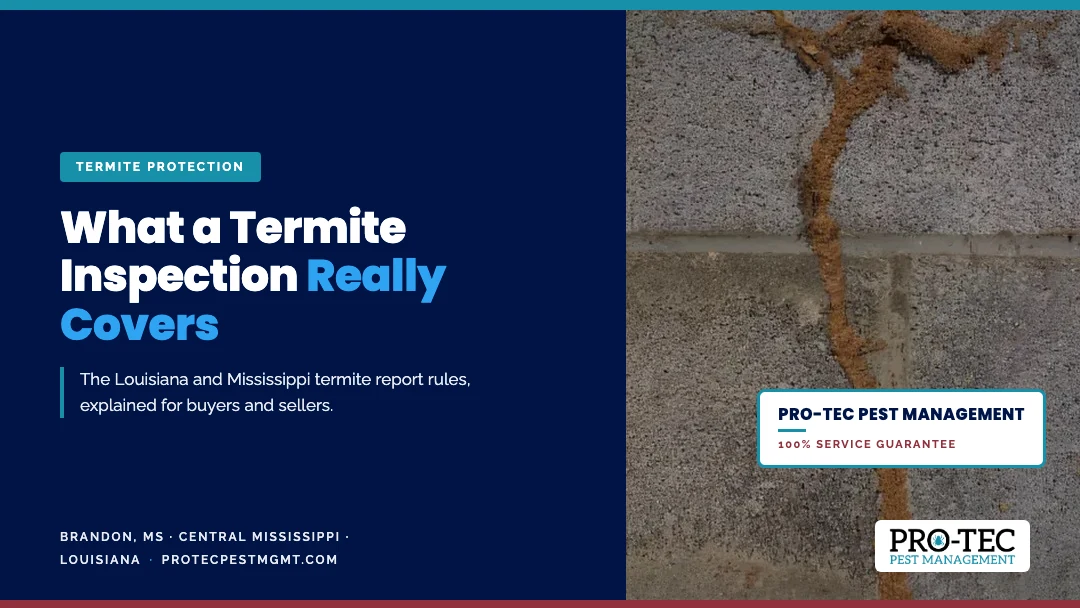
A mud tube is a covered highway. Subterranean termites dry out in open air, so they build shelter tubes to travel between the soil and the wood they are eating.
The University of Kentucky’s entomology guidance on termite control describes these earthen “mud” tubes as “typically about the diameter of a pencil, but sometimes can be thicker,” extending over foundation walls, support piers, sill plates, and floor joists. That pencil width is the quickest way to separate a real tube from a random dirt smear or a wasp nest.
Where to look: the outside of the foundation, the inner foundation wall, support piers, plumbing penetrations, and the crawl space. Mississippi State University Extension guidance on signs of termite infestation notes tubes traveling up the foundation “either outside or in the crawl space.”
The activity test. The same MSU Extension guidance gives a test any homeowner can run: “Carefully break a 1-inch section of the tube and watch to see if you observe termites or if they repair the tube over the next few days.” A rebuilt tube means a working colony. An abandoned tube may be old, but it still proves termites had a route in at some point.
One caution: break out a small section for the test and leave the rest alone. Tearing down every tube you find scatters the workers and makes the inspection that follows harder to read.
Swarmer Wings or Flying Ant Wings?
Swarmers are the reproductive stage, and they shed their wings almost immediately after flying. A small pile of identical wings on a windowsill, in a spiderweb, or by a door is the version of this sign most people actually find.
The confusion is with flying ants, which swarm in the same seasons. MSU Extension’s side-by-side comparison of termite and ant swarmers is the clearest test, and you can do it with the wings alone. Termites have “front wings and hind wings equal in length,” while an ant’s “front wings notably longer than hind wings.” If you still have the insect: termite “antennae straight and beadlike” versus an ant’s “distinct elbow or angle,” and a termite has “no waist, abdomen broadly joined to thorax” where the ant’s is “narrowly joined.”
This one matters because of what it implies. Winged termites indoors, per the same University of Kentucky termite guidance, “almost always indicates an infestation warranting treatment.” Swarmers outside in the yard are a normal seasonal event and a reason to check your own structure, not a verdict on it.
Hollow Wood Under a Surface That Looks Fine
Termites eat wood from the inside, which is why this sign hides so well. The University of Kentucky guidance describes termite-damaged wood as “hollowed out along the grain, with bits of dried mud or soil lining the feeding galleries,” and notes “the outer surface usually remains intact.”
That mud lining is a useful discriminator. Water damage and wood rot leave stained, soft, or crumbling wood, with no soil packed into the channels. If you probe a suspect spot with a screwdriver and find clean hollow galleries streaked with dirt, that is insect work, not moisture alone.
Tap along baseboards, door frames, window sills, and floor joists. Wood being eaten from within sounds papery or hollow next to the solid sound of sound lumber, even where the paint above it is unbroken.
Gritty Pellets, and Why They Are Rare Here
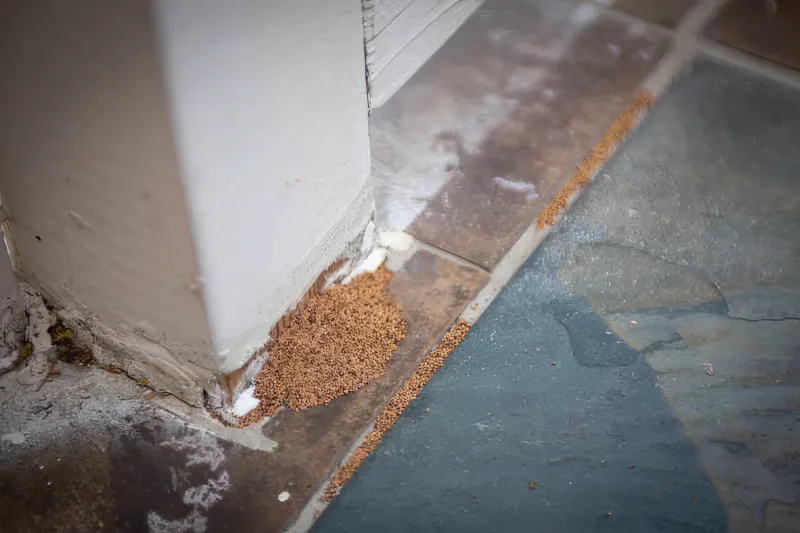
Drywood termites live inside the wood without soil contact, and they push waste out through small openings. MSU Extension’s entomology note on drywood termite fecal pellets describes “kickout holes” cut to the outside of the wood, and pellets with “a distinct, 6-sided, oblong shape” that are “relatively uniform in size,” with color varying by wood type.
People sweep these up as sawdust. As MSU puts it, “when viewed from normal, eyeball distance, these fecal pellets look like dust or debris.” Up close the difference is real: uniform six-sided pellets that feel gritty, versus the irregular fibers and shavings that come off a saw or a drill.
Here is the regional part that most national articles skip. Drywood termites are uncommon in this market. That same MSU note reports they are “not very common here” and that “less than one percent of the termite infestations reported in Mississippi involve drywood termites.” So pellets are worth identifying, but in Mississippi and Louisiana the far likelier culprit is a subterranean termite, which leaves mud rather than pellets.
What Each Signal Means for Urgency
The signals do not carry equal weight. This is how we triage a call at Pro-Tec.
| What you found | What it usually means | How fast to act |
|---|---|---|
| Mud tube, rebuilt after the test | Active subterranean colony with a route to the structure | Now. Schedule an inspection. |
| Mud tube, not rebuilt | A route existed at some point, and activity is unconfirmed | Soon. Get it read by an inspector. |
| Swarmer wings indoors | Almost always an infestation warranting treatment | Now. |
| Swarmers outdoors only | Normal seasonal flight nearby | Check your own foundation and wood. |
| Hollow wood with mud in the galleries | Feeding damage, extent unknown | Now, and do not disturb it further. |
| Gritty six-sided pellets | Drywood termites, rare in this region | Soon, with identification first. |
Species matters for the plan that follows. Native subterranean termites are found throughout Louisiana, and the LSU AgCenter calls the invasive Formosan subterranean termite “the most destructive insect in Louisiana.” MSU Extension’s termite infestation signs guide puts Formosan swarmers at about half an inch long including the wings.
What to Do Before You Call Anyone
Five minutes of care here makes the inspection that follows far more accurate.
- Leave it in place. Do not spray it, scrape it off, or clear the pellets away. An inspector reads the evidence you found.
- Photograph it with something for scale in the frame. A pen or a coin next to a mud tube settles the pencil-width question immediately.
- Write down where it was. Which wall, which side of the house, how high off the ground, inside or outside.
- Sweep the rest of the perimeter for more tubes, and note any wood touching soil, damp spots, or mulch piled against the siding.
- Skip the hardware store spray. Over-the-counter products aimed at a visible tube do not reach a subterranean colony, and the money is better spent on the inspection. Our breakdown of professional pest control versus the DIY route over five years runs the real numbers.
If you are buying or selling, the report your lender wants is a separate document with its own rules, covered in our guide to what a termite inspection covers in Mississippi and Louisiana.
Not sure what you are looking at? Send us a photo. Pro-Tec Pest Management inspects homes across Mississippi and Louisiana and will tell you plainly if what you found is termite activity.
Common Questions About Termite Warning Signs in Mississippi and Louisiana
These are the questions homeowners ask us after finding one of the four signals above. If yours is not here, call and describe what you found.
What do termite mud tubes look like?
They are earthen tunnels, typically about the diameter of a pencil, running along foundation walls, support piers, sill plates, and floor joists. They are built of soil and look like a raised dirt line climbing a surface. Anything much narrower or wider, or not attached to the structure, is usually something else.
Is that sawdust or termite frass?
Drywood termite pellets are six-sided, oblong, and relatively uniform in size, and they feel gritty. Sawdust is irregular fibers and shavings. Drywood termites are rare in Mississippi, where they account for fewer than one percent of reported termite infestations, so pellets are worth identifying carefully.
What do discarded termite wings mean?
They mean swarmers flew and shed their wings nearby. Termite wings are all the same length, while a flying ant’s front wings are notably longer than its hind wings. Wings found indoors almost always point to an infestation that warrants treatment.
How do I know if wood damage is termites or water damage?
Termite-damaged wood is hollowed out along the grain with bits of dried mud or soil lining the galleries, and the outer surface usually stays intact. Water damage and rot leave stained, soft, or crumbling wood with no soil in the channels.
Does a broken mud tube mean the termites are gone?
No. Breaking a one-inch section out of a tube is a test, not a treatment. If the tube is repaired within a few days, the colony is active. An unrepaired tube only means that route is not in use, and the colony may still be feeding elsewhere.
One sign is enough to justify a look. Pro-Tec Pest Management provides termite control across Mississippi and Louisiana, including Brandon and Baton Rouge. We will tell you what is active, what is old, and what it takes to stop it.