
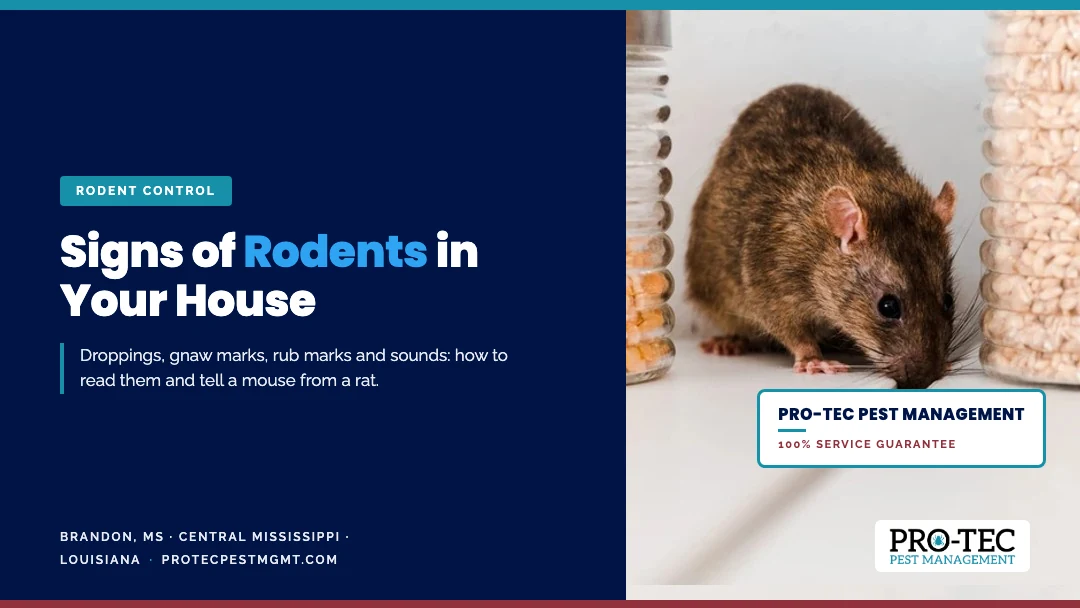
How Do You Know If You Have Rodents in the House?
Quick answer: Look for droppings, gnaw marks, greasy rub marks along walls, shredded nesting material, a musty odor, and scratching sounds at night. Droppings and gnaw marks are the two signs the CDC points to first. Where you find them, and how big they are, usually tells you if you have mice or rats.
TLDR:
- Droppings come first. They tend to show up before anyone sees a mouse or rat.
- Size and height matter. Signs high in the house point one way, signs near the foundation another.
- Gnaw marks can be old. Fresh droppings after a careful cleanup are the better test.
- Listen after dark. Rats are mostly active at night.
- Never sweep or vacuum droppings. Wet them with disinfectant first.
Mice and rats look for shelter when the weather cools, and Mississippi and Louisiana homes give them plenty of it. Our Mississippi rodent prevention guide covers keeping them out. This guide covers the step before that: reading the evidence when you think they are already inside.
Seeing signs already? Pro-Tec will inspect your home, confirm what you are dealing with, and find where it is getting in.
Rodent Droppings: The Sign You Will Usually See First
Most rodent problems are found by their droppings, not by a sighting. That is because rodents keep out of sight while they leave plenty behind.
The CDC’s 2024 rodent control guidance says the first signs usually appear before you see a rat or mouse. Droppings are common in cabinets, drawers, and other places out of plain sight. The CDC describes them as pointed at one end and often containing hair.
Volume is part of the picture. NC State Extension’s December 2024 guide to structure-invading mice says a mouse can produce 50 to 75 droppings per day. It describes them as roughly a quarter to a half inch long, brown to black, with tapered ends.
Look along walls, in corners, under sinks, and anywhere food is stored. A few droppings in one drawer and a trail along a pantry wall tell two different stories, so note where each one is.
Gnaw Marks and Chewed Packages
Gnawing is the second sign most homeowners find. It is also the one most easily misread.
The CDC explains that rats and mice gnaw to make better access points and to keep their teeth at the right length. It also warns that gnaw marks alone may only mean rodents were active at some point. They tend to turn up in the same areas as droppings.
Tooth size helps separate the two. The University of California’s Pest Notes on rats, updated in 2025, says rats leave tooth marks of about 1/6 inch (4 mm). Mice leave smaller, scratchy marks of about 1/12 inch (2 mm).
Inside the house, check door bottoms, wood trim, cabinet corners, and food packages in the pantry. NC State’s guide includes a photo of a tea package chewed open by mice.
Every Sign, and Where to Look for It
Most homes show more than one sign at once. This table pulls them together so you can check each area in one pass.
| Sign | What it looks like | Where to look |
|---|---|---|
| Droppings | Pointed at one end, often with hair. Mouse droppings about 1/4 to 1/2 inch | Cabinets, drawers, under sinks, along walls |
| Gnaw marks | Rat tooth marks about 1/6 inch, mouse marks about 1/12 inch | Door bottoms, trim, stored food packages |
| Rub marks | Dark smudges where fur brushes the same surface | Beams, rafters, pipes, walls |
| Nests | Shredded paper, insulation, boxes or fabric | Wall voids, stored boxes, cluttered garages |
| Odor | A musty smell linked to mouse urine | Closed cabinets, closets, storage areas |
| Sounds | Scratching in walls, noise in the attic or a drop ceiling | Walls, attic, ceilings, mostly at night |
| Burrows | Holes in the soil | Along the foundation, under garbage cans and compost |
One sign on its own can be old. Two or three together in the same area are a strong reason to look closer.
Found two or more of these? We can confirm the species and track it back to the entry point.
Rub Marks and Runways
Rodents travel the same routes again and again. Over time, those routes leave marks you can see.
UC’s Pest Notes on rats lists smudge marks caused by rats rubbing their fur against beams, rafters, pipes, and walls. It also notes rats traveling along utility lines or the tops of fences at dusk.
A dark, greasy stripe along a baseboard or around a pipe opening is worth a second look. It often sits right next to the gap the animal is using, which makes it a useful lead for the next step.
Sounds and Smells
Some of the clearest signs never show up on a counter. You hear or smell them first.
NC State’s guide names a musty smell associated with mouse urine, along with scratching and clawing noises inside wall voids. UC’s Pest Notes adds noises coming from the attic or drop ceilings, and says rats are mostly active at night.
So the best time to listen is after the house goes quiet. Note where the sound comes from: inside a wall, overhead, or under the floor. That location narrows down which rodent you have.
Nests and Outdoor Clues
Nests are harder to find because they sit in hidden spaces. When you do find one, it is strong evidence that rodents are living inside, not just passing through.
NC State says mouse nests are often hidden in wall cavities and look like chewed paper, insulation, boxes, or fabric. UC’s Pest Notes points to rat nests behind boxes, in cluttered garages, and in woodpiles.
Check outside too. UC’s guidance lists burrows beneath garbage cans and compost piles, and says Norway rats build burrows along building foundations.
Mouse or Rat? Read Where the Signs Are
Knowing which rodent you have changes where you look for the way in. Height is one of the best clues.
According to UC’s 2025 Pest Notes on rats, when both rat species share a building, Norway rats typically stay in the basement and ground floors while roof rats take the upper floors. Roof rats favor attics, wall voids, false ceilings, and cabinets.
Droppings in the pantry and small, scratchy gnaw marks point to mice. Noise overhead points to roof rats. Burrows near the foundation and signs on the ground floor point to Norway rats. Once you know which one, our walk-through of where mice actually get in shows how to trace the entry points.
Is It Still Active? The Clean-and-Check Test
Old evidence can sit in a wall or cabinet for a long time. The question that matters is if rodents are there now.
The CDC’s answer is simple: safely clean the area, then check it again. If new droppings appear after cleaning, rodents are still active. The same approach works for gnaw marks.
If the answer is yes, the next question is where they are getting in.
Clean carefully. The CDC’s 2024 clean-up instructions say never to sweep or vacuum droppings, urine, or nesting material, because that can put tiny droplets carrying viruses into the air. Instead:
- Put on rubber or plastic gloves.
- Spray the droppings with a bleach solution (1.5 cups of household bleach in 1 gallon of water) or an EPA-registered disinfectant until very wet.
- Let it soak for 5 minutes, or as long as the product label says.
- Wipe it up with paper towels and throw them in a covered garbage can.
- Mop or sponge the area with disinfectant, then wash your gloved hands before removing the gloves.
If you are finding a lot of droppings, or nesting material in an attic or crawlspace, the CDC notes that heavy infestations call for added precautions. That is a good point to bring in a professional.
What Pro-Tec Does When You Find Signs
Signs tell you something is there. They do not tell you how it got in or how many there are.
Our rodent control service starts with an inspection to find entry points and nesting areas. From there, we build a plan for your home that targets the rodents you have and helps keep new ones out. We follow the evidence to the source rather than guessing.

We serve homeowners across Central Mississippi and South Louisiana, with rodent control in Brandon, Meridian, Walker, Denham Springs, and Baton Rouge.
Common Questions About Signs of Rodents in the House
These are the questions homeowners ask most once they spot the first droppings. If yours is not here, give us a call.
What do mouse droppings look like?
NC State Extension describes mouse droppings as roughly a quarter to a half inch long, brown to black, with tapered, pointed ends. The CDC adds that rodent droppings are pointed at one end and often contain hair. You will usually find them in cabinets, drawers, under sinks, and along walls.
How can I tell if rodent droppings are old or new?
The CDC recommends a simple test. Clean the area safely with disinfectant, without sweeping or vacuuming, and check it again over the next few days. If new droppings appear after the cleanup, rodents are still active. Gnaw marks alone may only mean rodents were there at some point.
Can you hear mice or rats in the walls?
In many cases, yes. NC State Extension lists scratching and clawing noises inside wall voids as a sign of mice. UC’s Pest Notes points to noises from the attic or drop ceilings, and says rats are mostly active at night, so listen after the house goes quiet.
What are rodent rub marks?
Rub marks, also called smudge marks, are dark, greasy stripes left when rats rub their fur against the same surfaces as they travel. UC’s Pest Notes lists them on beams, rafters, pipes, and walls. They usually sit right beside the gap the animal is using to get in.
Is it safe to vacuum or sweep mouse droppings?
No. The CDC says not to vacuum or sweep rodent droppings, urine, or nesting material, because it can put tiny droplets carrying viruses into the air. Wear gloves, soak the droppings with a bleach solution or disinfectant for 5 minutes, then wipe them up with paper towels.
How do I know if I have mice or rats?
Look at size and location. UC’s Pest Notes says rat tooth marks are about 1/6 inch and mouse marks about 1/12 inch. Signs high in the house, like attic noise, point to roof rats. Burrows and signs near the foundation point to Norway rats.
Not sure what you are dealing with? Let us inspect, identify the rodent, and show you exactly where it is getting in.