Protect Compliance, Reputation, and Daily Operations
Quick Answer: A real restaurant pest control plan in Baton Rouge should include inspection, monitoring, treatment, exclusion recommendations, service documentation, and recurring follow-up. In South Louisiana, heat, humidity, frequent deliveries, drains, dumpsters, and unannounced health inspections make reactive pest control risky and expensive for restaurant owners.
TLDR
- Restaurant pest control is not just about killing pests after a sighting. It is about preventing violations, contamination risk, and customer-facing problems.
- Louisiana restaurants face year-round pest pressure because warm, humid conditions support roaches, rodents, flies, and other kitchen pests.
- The FDA Food Code requires food establishments to stay free of insects, rodents, and other pests, and Louisiana health inspections are generally unannounced.
- A strong service plan includes inspection, treatment, monitoring, documentation, and practical recommendations for entry points, sanitation risks, and trouble areas.
- Monthly service is often the right fit for higher-risk restaurants, while some lower-risk operations may use a different schedule based on layout, activity, and pest history.
- Good documentation matters. Service logs, findings, and corrective recommendations can help operators stay ready for inspections and internal audits.
- If you run a restaurant in Baton Rouge, Denham Springs, Walker, Prairieville, Zachary, Central, or nearby, it is smarter to schedule proactive service than wait for the next pest sighting.
Restaurant owners in Baton Rouge do not need vague pest advice copied from some dry-state blog that has never seen a greasy back door, a wet mop sink, and a drain line in July. They need a clear picture of what a real service plan should include, what inspectors and technicians look for, and how to reduce risk before a single sighting turns into a bigger problem.
What a Restaurant Pest Control Service Plan Should Actually Include
Restaurant pest control should do more than show up, spray, and disappear until the next panic call. A real commercial plan should help you prevent infestations, document risk, and respond quickly when conditions change.
At a minimum, a strong restaurant service plan should include a site inspection, pest activity review, treatment recommendations, recurring service, and written documentation. It should also account for kitchen layout, sanitation pressure points, delivery patterns, entry points, and hard-to-reach areas such as floor gaps, drains, and equipment voids.
| Service Plan Element | Why It Matters | What Owners Should Expect |
| Initial inspection | Finds activity, entry points, and sanitation risks | Kitchen walkthrough, storage review, exterior check, risk notes |
| Custom treatment plan | Aligns service with layout, hours, and pest pressure | Targeted service based on restaurant conditions, not a generic route stop |
| Recurring service schedule | Prevents small issues from building up | Monthly or other appropriate cadence based on risk |
| Monitoring and follow-up | Tracks recurring trouble spots and seasonal changes | Trend review, rechecks, and updates as needed |
| Documentation | Supports inspection readiness and internal accountability | Logs, findings, treatment notes, and recommendations |
A service plan should also work with your operation, not against it. That means scheduling around service hours, limiting disruption, and focusing on the areas that actually drive pest problems in restaurants. This is where a specialized provider is worth more than a low-effort stop-and-spray routine.
That becomes even more important in Baton Rouge, where the local climate and food-service environment create year-round pressure instead of a tidy seasonal problem.
Need a restaurant-focused plan, not a generic spray visit? Pro-Tec Pest Management provides restaurant pest control, roach control, rodent control, and preventative pest control for food-service businesses across South Louisiana. Fill out the form to get your schedule an appointment today:
Why Baton Rouge Restaurants Need a More Proactive Approach
Baton Rouge restaurants do not get much margin for error. Warm temperatures, high humidity, heavy delivery traffic, grease buildup, exterior lighting, shared commercial corridors, and wet service zones all create conditions that pests like. Add unannounced inspections to the mix, and reactive service starts looking like a bad management habit.
According to the Louisiana Department of Health, the state’s retail food program permits and inspects nearly 32,000 retail food operations, and inspections are generally unannounced unless they are follow-up visits. Restaurants are inspected on a risk-based schedule, which means operators need to stay prepared rather than hoping problems remain hidden until next quarter.
The FDA Food Code also puts the duty on food establishments to maintain premises free of insects, rodents, and other pests. That means restaurant pest control is not a cosmetic add-on. It is part of food safety, facility management, and brand protection.
- High humidity supports pest survival and reproduction.
- Back doors, deliveries, and dumpsters create a risk of repeat entry.
- Drain areas and under-equipment spaces stay warm and moist.
- Shared walls in commercial centers can increase exposure.
- Inspection pressure means ‘we will deal with it later” is a weak plan.
In short, the conditions in South Louisiana punish delay. That is why restaurant owners need a plan designed to reduce risk before the first customer complaint or inspector note lands on the table.
Once you understand the operating environment, the next question is obvious: which pests create the biggest problems inside commercial kitchens and restaurant buildings?
The Pests That Cause the Biggest Problems in Commercial Kitchens
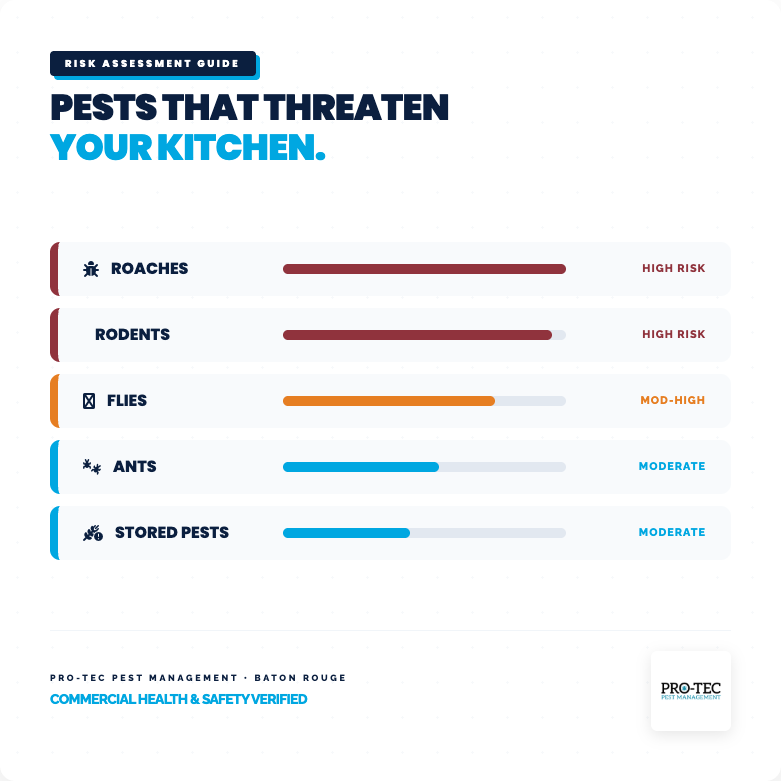
Not every pest creates the same level of operational risk. Some contaminate food areas, some damage inventory or wiring, and some create the kind of visible customer experience problem that spreads faster than management would like. In restaurants, the usual suspects are not subtle.
Cockroaches
Roaches are among the most serious restaurant pests because they thrive in the very conditions commercial kitchens provide: warmth, moisture, food residue, and tight harborage areas. They hide behind equipment, inside wall voids, near drains, around dish areas, and in dark, humid gaps that staff rarely see during routine cleaning.
Research published in PubMed and PubMed Central has found that cockroaches in food-related environments can carry bacteria of public health concern, including Salmonella and E. coli. That is one reason even a small roach issue in a restaurant deserves fast attention.
Restaurants dealing with recurring roach activity should not rely on spray-first thinking alone: inspection, sanitation correction, and targeted treatment matter more.
Roaches are bad enough on their own, but rodents introduce a different kind of contamination and structural risk that operators cannot afford to ignore.
Rodents
Rodents create obvious contamination concerns, but the damage goes beyond droppings near dry storage. Mice and rats can move through wall voids, ceilings, utility penetrations, and receiving zones, spreading waste and damaging packaging, insulation, and wiring along the way.
The CDC notes that rodent urine, droppings, and saliva can contaminate food and surfaces. In restaurant settings, that means one overlooked access point or storage issue can quickly become a larger sanitation problem.
Restaurants often need overlapping control strategies rather than pretending the issue fits neatly into one pest category because reality rarely respects your spreadsheet.
Flies and occasional invaders may look less dramatic at first, but they often point to the same underlying issues with moisture, waste handling, and access control.
Flies and Other Occasional Invaders
Flies, gnats, ants, and stored-product pests can all become headaches for restaurants, depending on waste management practices, door habits, food storage, and moisture control. Drain flies and other small flying pests often indicate sanitation or moisture issues. Ants and occasional invaders may indicate entry gaps or exterior conditions that need attention.
The key is not to treat each pest sighting as a totally separate mystery. Strong restaurant service plans look for the conditions that allow multiple pest issues to keep returning.
That leads directly into what inspectors and pest professionals are actually trying to find when they step into a restaurant.
What Inspectors and Pest Professionals Are Looking For
A good pest control provider is not just looking for live pests. They are looking for evidence, conditions, and patterns that make pest problems likely. That is also why operators should expect more from service visits than a quick treatment note and a wave on the way out.
The FDA Food Code states that pest control in food establishments includes routinely inspecting incoming shipments and the premises for evidence of pests, using control methods when pests are found, and eliminating harborage conditions. It also emphasizes protecting outer openings against entry through sealed gaps and properly fitted doors and windows.
| What Gets Checked | Why It Matters | Common Restaurant Trouble Areas |
| Evidence of activity | Shows whether pests are present now | Droppings, rub marks, cast skins, dead insects, grease trails |
| Entry points | Explains how pests keep getting in | Back doors, utility penetrations, gaps around plumbing, and loading areas |
| Harborage zones | Shows where pests live and multiply | Drains, under equipment, mop sinks, storage clutter, and voids |
| Sanitation risks | Identifies what is feeding or supporting pests | Grease, crumbs, standing water, waste overflow, poor rotation |
| Documentation readiness | Supports inspections and audit response | Missing logs, vague notes, and no corrective recommendations |
The real value here is that inspection and pest service should connect to operations. A pest technician should help you spot where your facility is vulnerable, not just leave a note that says “treated as needed” and call it a day.
A good pest control provider is not just looking for live pests. They are looking for evidence, conditions, and patterns that make pest problems likely. If you want a broader look at why routine inspections matter before activity becomes obvious, read our guide on regular pest inspections.
That also explains why service frequency matters so much. Some restaurants can limp along longer than they should, but many need a tighter schedule to stay ahead of recurring pressure.
How Often Should a Restaurant Schedule Pest Control?
This is one of the most common questions restaurant owners ask, and for good reason. Nobody wants to overpay for service. Nobody wants to under-service the building either, and then learn the expensive way that the cheaper plan was fake savings.
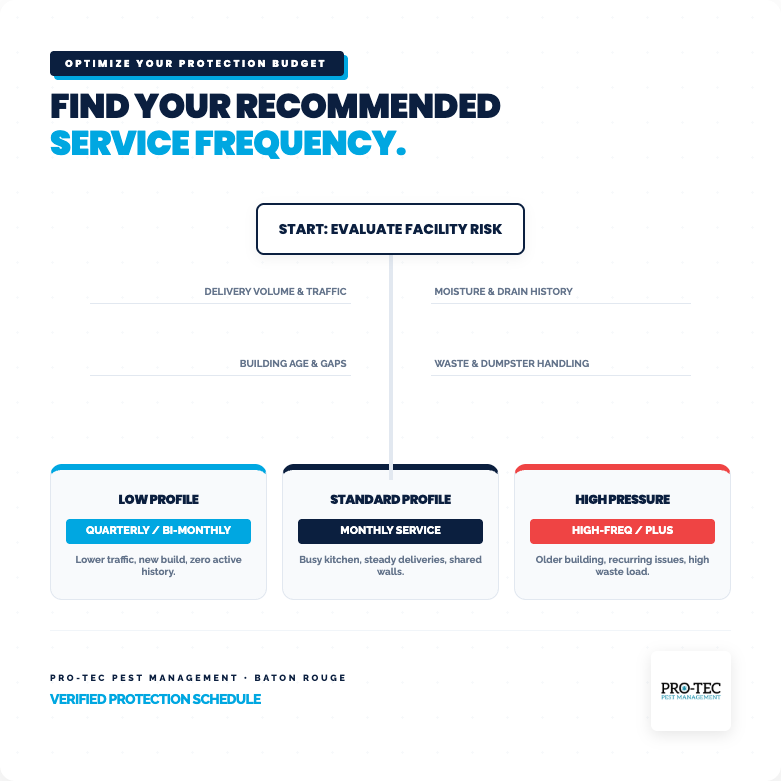
The right schedule depends on your risk level, not just your square footage. A busy kitchen with frequent deliveries, high moisture, older structural gaps, and prior activity usually needs more consistent service than a lower-risk space with simpler operations.
- Monthly service: often appropriate for restaurants with high traffic, recurring pressure, prior activity, or complex kitchen conditions.
- More frequent service or follow-up may be needed after active issues, sanitation corrections, or emergency calls.
- Less frequent service: may fit some lower-risk operations, but only when inspection findings, sanitation, and building conditions support that approach.
| Risk Factor | Why It Changes Service Frequency |
| High delivery volume | More packaging, more door traffic, more exposure |
| Moisture and drain issues | Supports roaches, flies, and other kitchen pests |
| Older building or shared walls | Creates more gaps, voids, and migration pathways |
| Prior pest history | Raises the chance of recurring activity |
| Waste handling challenges | Supports rodents, flies, and repeat attraction |
A good provider should be able to explain why they recommend a schedule. If the answer sounds like a generic route template instead of a risk-based plan, that is a problem dressed up as convenience.
Restaurants that want fewer surprises between inspections usually benefit from a preventative pest control plan in Baton Rouge, especially when moisture, delivery traffic, drain activity, and recurring access points make reactive service too risky.
This is also the point in the conversation where documentation starts to matter more than many operators expect.
Need help deciding what service frequency makes sense for your restaurant? We can assess your layout, activity level, risk points, and pest history, then recommend a plan that fits the operation.
What Documentation You Should Expect From Your Pest Control Provider
Restaurant pest control should produce usable records, not vague paperwork that impresses nobody and helps even less. Documentation matters because operators, inspectors, district managers, and corporate teams all need a clear record of what was found, what was done, and what still needs attention.
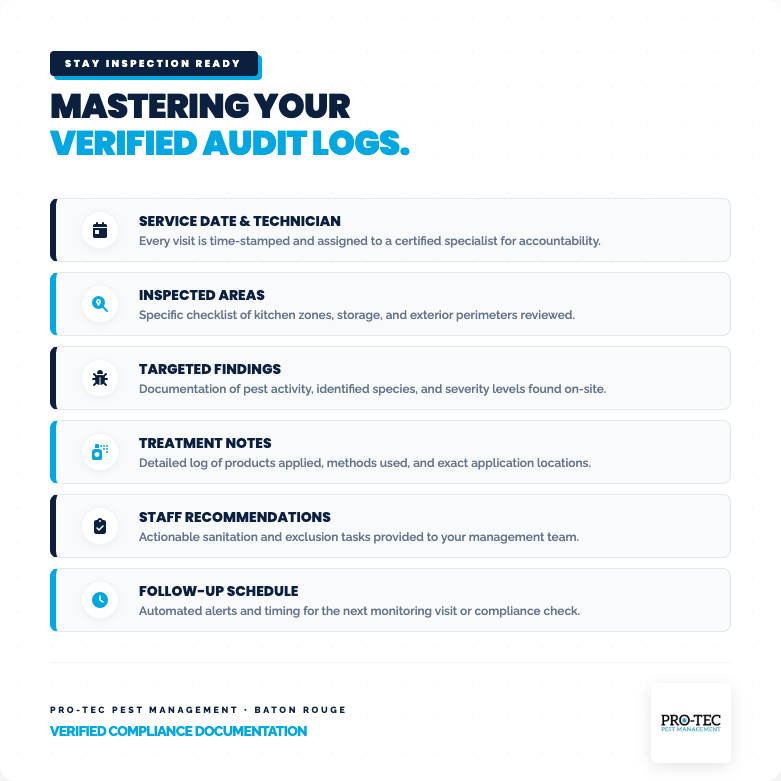
At a practical level, restaurant owners should expect service logs, treatment notes, findings, trend observations, and corrective recommendations. If the provider sees a gap under the back door, repeated activity near drains, or sanitation conditions that continue to attract pests, those issues should be documented clearly.
- Date of service
- Areas inspected and treated
- Pest activity noted
- Products or methods used as appropriate
- Corrective recommendations for staff or management
- Follow-up timing or monitoring notes
Documentation does two useful things. First, it helps you stay organized for inspections and internal review. Second, it helps show whether the problem is improving, recurring, or shifting to a new area. That kind of tracking is one of the clearest differences between a real commercial service plan and a light-duty stop.
When documentation is missing, vague, or inconsistent, it often indicates that the provider is working reactively rather than managing the account strategically.
That brings us to a blunt but useful question: how can you tell when your current provider is too reactive?
Signs Your Current Provider Is Too Reactive
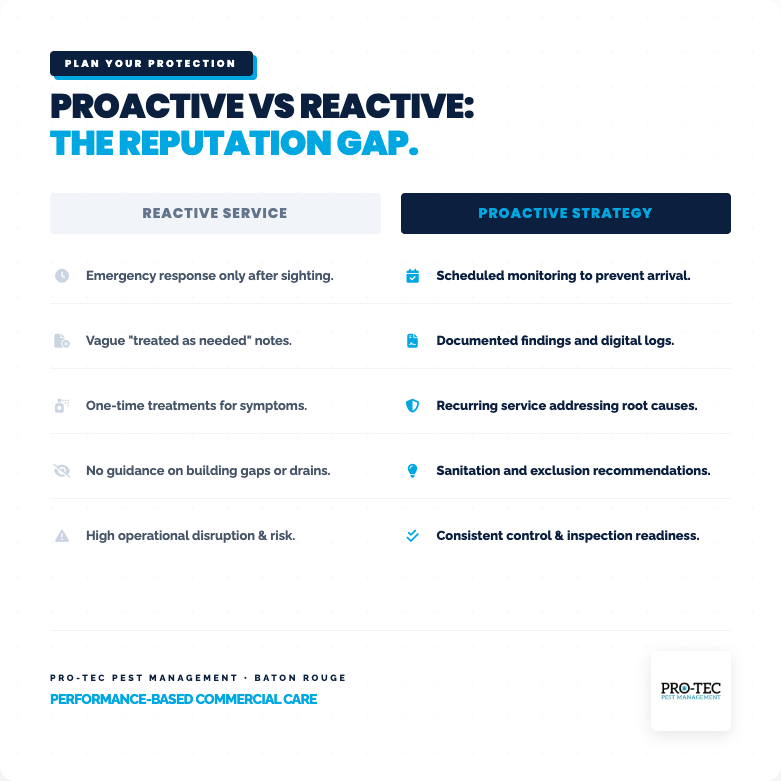
Some restaurant owners think they have a pest control plan when what they really have is a recurring invoice attached to very little strategy. If the provider only becomes active after a complaint or sighting, you are not getting prevention. You are paying to stay nervous between visits. That is also why professional pest control beats DIY or patchwork fixes when compliance, documentation, and repeat activity are on the line. Here’s signs that your current provider is too restrictive:
- They only respond after you report activity.
- There is little or no explanation for service frequency.
- You do not get useful findings or corrective recommendations.
- Recurring trouble spots are never tracked or discussed.
- No one talks about drains, access points, waste handling, or building gaps.
- Documentation exists, but it is too thin to be useful.
A proactive provider should help reduce repeat issues over time. That does not mean pests stop existing in Louisiana because the climate did not get the memo. It means you should see an organized inspection, targeted recommendations, and a plan that adapts to what the building is showing.
That is also why restaurant pest control protects far more than just your next inspection score.
Why a Service Plan Protects More Than Just Inspection Scores
Inspection performance matters, but it is not the only thing at stake. Strong pest control also protects food safety, customer trust, staff confidence, inventory, and day-to-day operations. One visible pest sighting can cause more damage than the cost of routine prevention ever will.
The CDC estimates that 1 in 10 people in the United States gets sick from foodborne illness. That does not mean every pest issue causes a foodborne illness. Still, it does explain why the risk of contamination in a food environment is taken seriously by regulators, operators, and customers alike.
| What a Service Plan Protects | Why It Matters to Restaurants |
| Food safety environment | Reduces contamination risk and sanitation failures |
| Customer trust | Visible pest issues can damage reviews and repeat business |
| Brand reputation | One incident can travel fast through word of mouth and online posts |
| Operational stability | Emergency calls and recurring issues disrupt staff and workflow |
| Inspection readiness | Supports cleaner records and a more organized response |
A good service plan buys control, visibility, and fewer surprises. That is a much better investment than waiting until roaches show up during prep or a rodent issue is noticed where it should not be.
If your restaurant is already showing signs of strain, the smartest move is to have the building reviewed before the next inspection decides for you.
Schedule Restaurant Pest Control Before the Next Sighting Becomes a Bigger Problem
If you run a restaurant in Baton Rouge, Denham Springs, Walker, Prairieville, Livingston Parish, Zachary, Central, or nearby, proactive pest control is one of the easiest ways to reduce a problem that gets expensive fast when ignored. The right plan should fit your kitchen, your schedule, and your actual risk level.
At Pro-Tec Pest Management, we provide restaurant pest control services, including preventive pest control, roach control, and rodent control, for Louisiana businesses that need reliable, documented service.
Ready for a clearer next step? Contact Pro-Tec Pest Management for a free estimate, and let us help you build a restaurant pest control plan that protects your operation before the next sighting becomes a bigger issue.

Protect your kitchen before pests threaten your reputation. Get a free estimate, review your risk points, and get a service recommendation that fits your restaurant, instead of forcing it into a generic route stop.
Questions Restaurant Owners Ask Before Starting Service
Most restaurant owners are not looking for a lecture on entomology. They want to know what kind of service they actually need, how often they need it, and what will help them stay ahead of inspections, customer complaints, and recurring activity. These are the questions that usually sit between concern and action.
How often should a restaurant get pest control in Louisiana?
That depends on the operation, building condition, pest history, and exposure level. Many restaurants benefit from monthly service due to delivery traffic, moisture, waste management, and year-round pest pressure. Higher-risk operations may need tighter follow-up at times, while lower-risk facilities may qualify for a different schedule based on inspection findings.
What pests are most common in Baton Rouge restaurants?
Roaches, rodents, flies, gnats, ants, and stored-product pests are common restaurant issues in South Louisiana. Warm temperatures, humidity, drains, grease, food residue, and frequent deliveries create conditions these pests like. The exact mix depends on layout, sanitation pressure points, and how well the building is sealed and maintained.
Is restaurant pest control safe around food prep areas?
Professional restaurant pest control should use targeted methods and products appropriate for food environments, while adhering to label requirements and safety standards. The goal is to control pests without creating unnecessary disruption or risk. Good service also includes inspection, monitoring, and corrective recommendations, not just treatment alone.
What should a restaurant pest control report include?
A useful report should include service date, areas inspected, findings, pest activity noted, methods used as appropriate, corrective recommendations, and any needed follow-up. Documentation should help management track recurring issues and stay organized for inspections or internal review.
Can rodent droppings or roach activity create food safety concerns?
Yes. CDC guidance notes that rodent waste can contaminate food and surfaces, and published research has found cockroaches in food-related environments can carry bacteria of public health concern. That is why visible activity should never be treated as a cosmetic problem in a restaurant setting.
Are restaurant inspections in Louisiana announced?
Not usually. The Louisiana Department of Health states that retail food inspections are generally unannounced, except for follow-up visits to verify compliance. That is one reason restaurants need a service plan that supports readiness all the time, not just after a complaint or right before an expected visit.