Restaurant Pest Control Records: Who Reads Them Besides the Health Inspector
Quick Answer: A verified pest control log is a dated, signed record of every inspection, finding, treatment, and fix in your restaurant. Health inspectors read it, and so can third-party food safety auditors, franchise brand reviewers, and insurers handling a claim. A complete log shows an active program. A thin one leaves you explaining from memory.
TLDR:
- The FDA Food Code requires routine pest inspections and pesticide use that follows the label. Your log is how you show both happened.
- In Mississippi, licensed pest operators must keep service records for two years, including the product’s EPA registration number.
- Third-party food safety auditors look at your whole pest program, and you stay responsible even when a contractor runs it.
- Franchisors usually control how franchisees operate, and that can include bookkeeping and performance standards.
- If a foodborne illness claim lands, dated records show what you did and when.
- A log is “verified” when each entry is dated, tied to a licensed technician, and closed out with a corrective action.
We service restaurant kitchens on both sides of the state line, from Brandon and Meridian in Mississippi to Baton Rouge, Denham Springs, and Walker in Louisiana. In a busy kitchen, pest paperwork is easy to put off until someone asks for it, and then it is the only thing that matters.
This guide covers who asks, what they look for, and how to keep a log that answers for you. It is general guidance, not legal or insurance advice.
Need pest control paperwork that holds up? Pro-Tec Pest Management provides recurring restaurant pest control across Mississippi and Louisiana, with a dated service report after every visit.
Who Reads Your Pest Control Log
Most owners think of the pest binder as health inspection paperwork. That is only one reader.
Each reader wants the same raw material: what was checked, what was found, what was done, and when. The sections below take them one at a time, starting with the rule that sets the baseline.
What the Food Code Expects on the Pest Side
The pest duty in a restaurant starts with the FDA Food Code. FDA describes the 2022 Food Code as a model offered for adoption by state and local governments, so it is the template most retail food rules build on.
Section 6-501.111 says the premises must be kept free of insects, rodents, and other pests. It names how: routinely inspect incoming shipments, routinely inspect the premises for evidence of pests, use methods such as traps if pests are found, and eliminate harborage.
Section 7-202.12 adds that a pesticide must be used as its label directs, with a label that allows use in a food establishment. Where certification is required, the work must also follow the conditions of that certification. The Code sets the duty. It does not hand you a log template.
That gap is where records come in. The Food Code’s annex describes active managerial control as a preventive approach built on “a continuous system of monitoring and verification.” A dated pest log is the plainest way to show that system exists on the pest side.
What Makes a Pest Control Log “Verified”
A verified log is one an outsider can check. Every entry should tie a date and a licensed person to a specific finding and a specific action.
Mississippi spells out what licensed operators must record. Under Rule 111.01 of the Mississippi Bureau of Plant Industry rules for commercial pest control, last amended in November 2024, licensees keep complete records of all work for two years. Each record includes the location, service performed, date, pest controlled, product brand name, EPA registration number, amount used, and dilution rate.
In Louisiana, the Louisiana Department of Agriculture and Forestry states that an individual must be licensed to control pests, and unlicensed technicians must work under a licensed supervisor. Licensing is the anchor that gives every log entry a name and a credential behind it.
Those are your provider’s records. Your restaurant’s log should mirror them, so the two tell the same story.
| Log Field | What It Proves | Who Cares Most |
|---|---|---|
| Visit date and time | Service is routine, not reactive | Inspector, auditor |
| Technician name and license | A qualified person did the work | Auditor, insurer |
| Areas inspected | The whole building gets checked | Inspector, franchisor |
| Activity found | You know where pressure is | Auditor, inspector |
| Product and EPA registration number | Pesticides fit a food setting | Inspector, auditor |
| Recommendation and completion date | Problems get fixed, not just noted | All four readers |
The last row is the one most logs miss. A finding with no completion date reads as an open problem, no matter how clean the kitchen looks today.
Third-Party Food Safety Audits Grade the Program
Some operations face audits beyond the health department, such as a kitchen that supplies product to grocers or a customer that requires a certified food safety system. These audits look at your pest program as a whole.

The Safe Quality Food Institute reported in a July 2023 review of top non-conformances under SQF Code Edition 9 that pest prevention was the leading non-conformance, with both critical and major findings.
The same review says responsibility stays with your organization even when a contractor runs the program, and it tells sites to stay involved and monitor the contractor’s performance. In practice, that means you need the contractor’s reports in hand and a record that you acted on them.
State food safety regulators make a similar point. The Florida Department of Agriculture and Consumer Services pest control plan checklist, revised in 2022, says a reputable contractor will provide records and reports verifying the program works, including proof of training, pesticide certification, and products approved for food establishments.
Want a pest program you can hand to an auditor? Our restaurant pest control service pairs recurring visits with documentation built in, so findings and fixes are on paper before anyone asks.
Franchise Standards and Pest Records
Franchise operators answer to one more reader. The specific rules live in your own franchise agreement and operations manual, so start there.
The Federal Trade Commission’s consumer guide to buying a franchise explains that franchisors usually control how franchisees conduct business to keep outlets uniform. The FTC lists examples, including requiring certain accounting or bookkeeping procedures.
The same guide notes a franchisor can end an agreement for reasons that include failing to meet performance standards. When a brand reviewer asks how your location handles pests, a complete log turns a judgment call into a document.
We are not describing any particular brand’s requirements here. Ask your franchisor what pest records it expects, then confirm your provider’s reports cover each item.
Insurance, Claims, and Liability
Pests and food safety claims are linked. The Florida checklist above calls pests in a food establishment a major cause of foodborne illness, and notes they can lead to administrative action, a re-inspection, or a stop sale.
On the coverage side, Insureon’s food contamination insurance guide, updated in September 2025, says general liability often includes food contamination coverage that protects a business sued over foodborne illness. It also notes business interruption insurance can help if a restaurant is forced to close temporarily.
When a claim or a dispute comes up, someone will ask what you knew and what you did. Dated service reports, closed corrective actions, and product records let you answer with paper instead of memory.
Coverage terms vary by policy. Ask your agent what documentation your carrier wants, and keep the pest log in a place you can produce quickly.
What Pro-Tec Leaves After Every Visit
Documentation is built into how we service commercial kitchens. After every visit, we leave a dated service report showing what was inspected, what was treated, and what we recommend correcting.
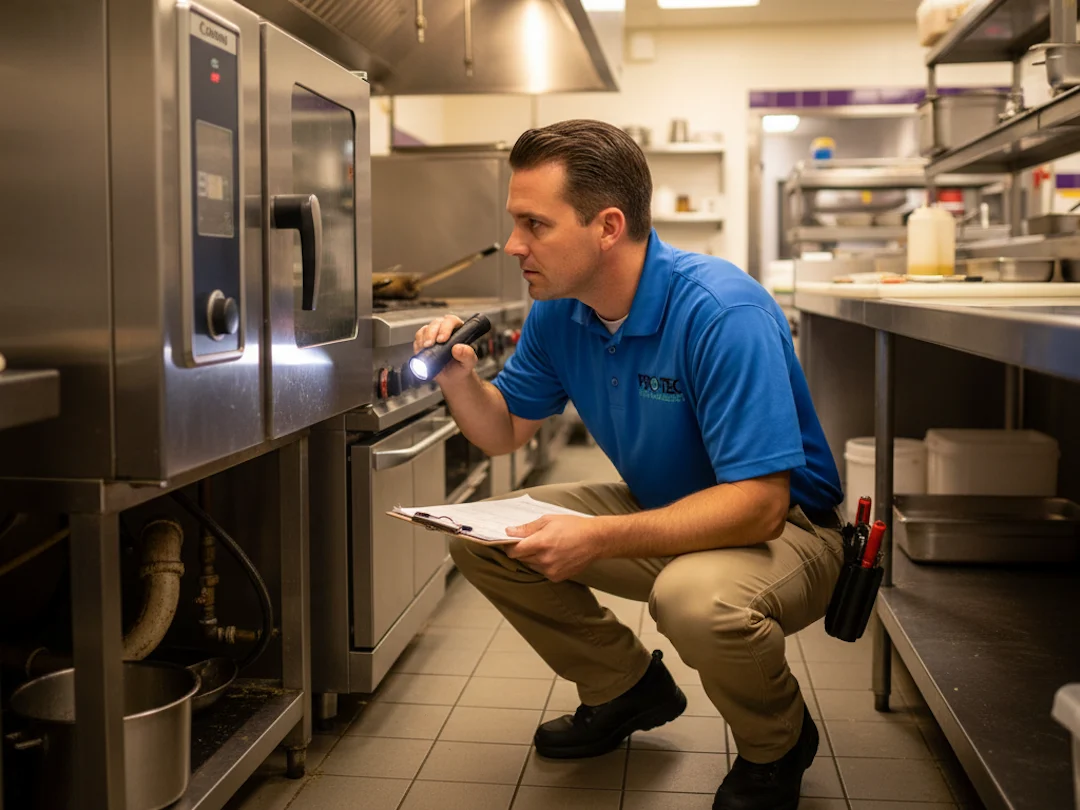
Our commercial kitchen pest control program runs on monthly or quarterly maintenance visits with full documentation. Our technicians are licensed, and the company is insured.
You keep that report in your log. When anyone asks who handles your pest control and how often, the folder answers before you have to. For more on the company behind the reports, see Pro-Tec’s background and service history.
How to Keep the Log Audit-Ready Between Visits
The service report covers what the technician did. Your staff’s part fills in the days between visits, and that is where most gaps start.
- Keep one home for the log. A single binder or one digital folder, not three places.
- Log staff sightings. Date, location, and what was seen. The Florida checklist recommends routine pest monitoring by employees and documenting what they find for the pest company.
- Close every recommendation. Write the date a gap was sealed, a drain was cleaned, or a door sweep was replaced.
- Keep the device map current. If stations or light traps move, the map should move with them.
- File the credentials. Keep copies of the technician license and product labels with the reports.
- Review monthly. Look for the same finding showing up twice. A repeat is a trend, and trends are what auditors ask about.
A log kept this way does double duty. It answers outside readers, and it shows your managers which trouble spots keep coming back.
Common Questions About Restaurant Pest Control Records
These are the questions restaurant owners and managers in Mississippi and Louisiana ask about pest records once an audit, a franchise review, or a claim makes the paperwork matter.
What should a restaurant pest control log include?
Each entry should show the visit date, the technician’s name and license number, areas inspected, pest activity found, products used with EPA registration numbers, and recommendations. Add the date each recommendation was completed. Staff sightings between visits belong in the same log, so the record covers every day, not just service days.
How long should a restaurant keep pest control records?
Check your own health department, franchise agreement, and any audit scheme first, since they can set their own periods. As a reference point, Mississippi requires licensed pest operators to keep records of their work for two years. Keeping your copies at least that long lines your log up with your provider’s.
Does my pest control company keep records too?
Yes. In Mississippi, licensed operators must keep records of all work for two years, including the product, EPA registration number, and amount used, and the state can examine them. Ask your provider for a copy of every service report, so your restaurant’s log matches theirs.
Is a digital pest control log acceptable?
A digital log can work well when it is organized, dated, and easy to pull up during a visit. What matters is that you can produce complete records quickly. Confirm with your health department, auditor, or franchisor if they have a format preference, and keep a backup.
Can good pest records help with an insurance claim?
They can help you show what was done and when, which matters in any dispute. Records do not guarantee a claim outcome, and coverage depends on your policy. Ask your insurance agent what documentation your carrier expects, and keep the log where you can produce it fast.
Get a pest log you never have to scramble for. Pro-Tec Pest Management serves restaurants across Mississippi and Louisiana with recurring visits and a dated report every time. No surprises, clear next steps.